Tuesday, November 28, 2006

Batavia’s Graveyard – history’s bloodiest mutiny (1629)


Though Captain Cook is credited with discovering Australia, Dutch trading ships had been sailing a course parallel to the continent’s west coast for almost 200 years. Of those ships, several had been lost off the uncharted coastline.

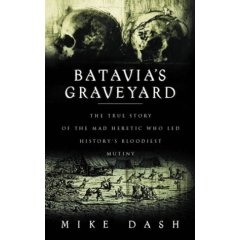
Mike Dash’s, Batavia’s Graveyard, is the true story, told in narrative form, of the worst civilian maritime massacre ever recorded.

In the autumn on 1628, the East Indiaman, Batavia, the largest and newest ships of the Dutch East India Company’s fleet set sail from Holland loaded with a King’s ransom in gold, silver and gems. She is bound for Java on a route which carries her close to the coast of the yet uncharted continent of Australia.
On board is Jeronimus Cornelisz, who during the voyage plots a mutiny with the Captain and other members of the crew.
When the ship is wrecked and the Company’s Agent sets sail in an open boat to seek help. He leaves over 200 survivors on the islands without water food or shelter.
In order to secure his survival, Cornelisz seizes control and begins to systematically kill the survivors. Without tainting his own hands, he forces his henchmen to hack to death more than 120 of men, women and children.
Batavia’s Graveyard is no fiction story. It is a poignant and chilling true re-enactment of the events which took place.
And it is said that if you happen to land at Houtman's Abrolhos, the tiny uninhabited archipelago just off Australia's west coast today, you can still find the sun-bleached bones of the victims.
Evocative, unbelievable and certainly unforgettable.

Batavia’s Graveyard by Mike Dash (2002)

Monday, November 27, 2006

HMS Beagle (replica) - to sail again


The vision of the Beagle Project Pembrokeshire is build a replica of the three masted barque which carried Darwin on his epic voyages (1831-1836). She will be “built of larch on oak frames, the hull will be copper sheathed and the boat will be fitted with modern propulsion, navigation, safety and communications equipment.”
Like the 1830’s vessel, she will be equipped with the latest technology, “to allow aspiring and practising scientists to use her as a platform from which to collect specimens and on which to store samples and stage experiments". She will be an inspiration to a new generation of scientists.
And on her first major voyage (2009) she will circumnavigate the globe, retracing the voyage the Beagle took in Darwin’s day.
The original ship:
When the Beagle was launched on the Thames in 1820, she was brig-rigged carrying only two masts with square-rigged sails. Because this design of ship sat low in the water and had a habit of turning-turtle if mishandled in heavy weather, it was sometimes referred to as a ‘coffin ship’.
In 1825, however, she was re-rigged as a barque with the addition of a mizzen (third) mast fitted with fore and aft sails. This configuration made the ship more manoeuvrable.
When HMS Beagle was commissioned in 1831 to continue survey work in the Southern Ocean, she was again refitted under the direction of Robert FitzRoy, her captain, who ensured she benefited from the latest in nautical technology. For example, for the first time in a Royal Navy ship, lightening conductors were fitted to all the masts.
At 235 tons, the Beagle’s masts and spars were extra strong, and chains had been used in place of ropes where possible.
It was under the command of skilled navigator and surveyor, Captain FitzRoy, the ship carried the young naturalist, Charles Darwin on the voyages which were to lead to his theory of evolution.

For more information on the Beagle Pembrokeshire Project go to:
The Beagle Project.

Photo (M. Muir - HMS Endeavour replica)

Friday, November 24, 2006

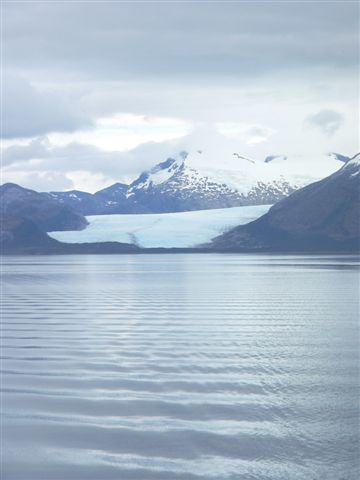
The Beagle Channel - revisited


There are still places in this world where you stand in awe.
Where there is an aura of solemnity.
The Beagle Channel is one of them - and it is something you don’t expect when you just around the corner from Cape Horn.
Apart from its stark beauty, what struck me about it was its solemn stillness.
Glaciers and ice make little sound.
New-fold mountains sleep, their great stubbled chins pointed skywards while above them condors the size of worker bees wheel in effortless in silent circles.
A thousand streams and waterfalls glisten as they slip relentlessly over honed rock faces only to disappear in the wooded banks below.
Penguins and occasional whales grace the water, while on the scattered rocky outcrops, seals wallow unperturbed while on tiny islands innumerable cormorants hold out their flaccid wings to dry.
Beneath the crystal waters, tall weeds wave their golden fronds as the small boat passes above them leaving barely a ripple on the surface.

The Beagle Channel stretches 120 miles long and two miles wide, and Charles Darwin likened it to the valley of Scotland’s Lockness.
In his words:
The lofty mountains rise to a height of 3,000 and 4,000 feet…covered by a wide mantle of perpetual snow, and numerous cascades pour their waters through the woods, into the narrow channel below. In many parts, magnificent glaciers extend from the mountainside to the water’s edge. It is scarcely possible to imagine anything more beautiful than the beryl-like blue of there glaciers and the dead white of the upper expanse of snow. (The Voyage of the HMS Beagle).

The Channel is probably unchanged since the time HMS Beagle made its first passage in the 1830s and it will be that same scene which will greet the replica ship when she sails south in a few years time.
Thanks to Peter Grath, I have just learned of the Beagle Project Pembrokeshire,
Zoologist, Peter, and David Lort-Phillips director of the Darwin Centre for Biology and Medicine in Wales are co-founders of the project to build a replica of the Beagle.
For more information on this project go to:
The Beagle Project.

Wednesday, November 15, 2006

Squidoo Lens

In case you are not familiar with SQUIDOO sites - they are called 'lens' and are somewhere between a website and a blog.
They are free from http://www.squidoo.com and are easy to set up.
Squidoo is also a place to search for subjects you are interested in written by folk like you and me.
The profit from the lens go to you or the charity of your choice.
Having just finished reading Imperium my mind wandered back to my holiday in Rome this summer, and to the other places I visited in the Mediterranean.
As a result, I have set up a new Squidoo lens about that cruising holiday (mainly from material I posted earlier on this blog).
You can check the new site at: http://www.squidoo.com/cruisingeurope
I'm following that with a site on Cruising Antartica and one on Sailing across the Atlantic.
As I don't watch TV, it keeps me out of mischief.

Of my other Squidoo lens the most popular is still Tall Ships followed by The Black Thread, the lens wich tells about my forthcoming novel.
You can find those two links on the heading of this page.

Saturday, November 11, 2006

Imperium by Robert Harris


Imperium (pub Sept 2006) is an incredible read - a fictionalized biography of Cicero, the Roman advocate, orator and writer who became one of the most powerful men in Roman history.

It follows Cicero's career from his early days as a young advocate to the point of him becoming consul-elect. Not an easy path to tread with enemies as powerful as Julius Caesar and later, Mark Antony.

Battling bribery, massive corruption and treachery, Cicero used the only weapon at is disposal – his voice – to win support for his ideals from the aristocrats, tribunes, senators and the people of Rome.

His story is told through the gentle voice of his
slave/secretary/confidant, Tiro.

For me, Harris's historical novel brings to life this segment of Roman history
Thoroughly recommended.

11th November - Rememberance Day


Lest we forget

Poppies, cultivated since the Middleages, have long been a symbol of rememberance. There are many varieties.
This is a beautiful, old-fashioned peony type bloom.
Photo: M Muir

Tuesday, November 07, 2006

Hornblower gets my ship's biscuit!


If you browse through Yahoo you will find specific groups dedicated to the various fictitious naval heroes - characters who have almost become household words, eg: Jack Aubrey, Richard Bolitho and Hornblower. And their creators are as well known as their protégés.
Having written one sea story (Sea Dust), and with a desire to write another, I decided it was time I investigated what it was that the authors of these characters wrote to attract such a large readership and to maintain them over a long period of time.
I tried Patrick O’Brian some time ago and only managed to finish Master and Commander. Half way through, The Far Side of the World, I stopped. For me, O’Brian’s prose consists of too many long sentences which need reading three times over. And he goes off at a tangents at times rather than sticking with the story.
I’ve also tried a couple of Alexander Kent’s. Unfortunately I couldn’t get the early books and started midway through the series where both Bolitho senior and Bolitho junior appeared. I found the double presence confusing.
My other comment is that in all Kent’s scenes at sea – I never once felt the movement of the ship!
Julian Stockwyn is on my list but I haven’t sampled his Kydd series yet.
Last week I bought the first six books of the Hornblower series and have already whizzed through book one and am now onto the second.
All I can say is I am loving the way CS Forester writes. Sure there are a lot of nautical terms but the settings are on fighting ships. Also there is plenty of action (much of it tongue in cheek) but the stories are what I would describe as rollicking good fun with lots of variety. His characters are interesting. I would describe Hornblower as mostly human with a tendency at times to superhuman qualities.
The series I would say encompasses the journey theme, the hero theme, good over evil story and even the Cinderella theme all rolled into one. They have all the ingredients of a good yarn and I’m looking forward to reading them all.
The complete series of CS Forester's Hornblower series are available from Amazon

Thursday, November 02, 2006

A long summer's day in Antarctica


For us here in Australia, the southern summer is just around the corner, while for you folk in the northern hemisphere, winter is looming.
Here's a thought!
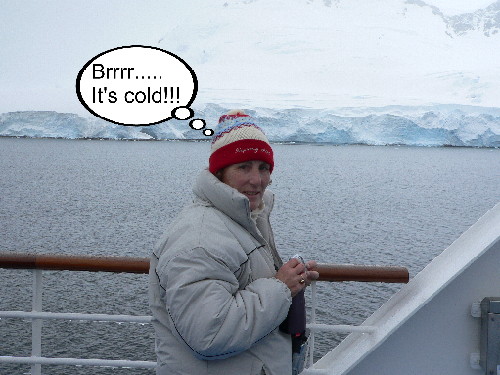
This picture was taken from the deck of the Oceania as the ship cruised the Antarctic Peninsula.
It was Boxing Day, 2004 - the middle of summer - and it snowed!!
Have to admit my hands were freezing but I couldn't operate the video recorder with gloves on.
What a fantastic experience that was!

Photo: PJ Ryan

Wednesday, November 01, 2006

Tall ship adventure - The White Squall


I thoroughly enjoyed watching the DVD of the White Squall.
It’s the true story of a tall ship adventure with a group of youths on a fully rigged sail training ship in the 1960s.
It brought back memories of my times on the STS Leeuwin and the voyages I took on the Indian Ocean a few years ago.
It also reminded me of the tropical low which struck the Star Clipper it neared the West Indies near the end of my voyage across the Atlantic.
Quite a storm – but what an experience!
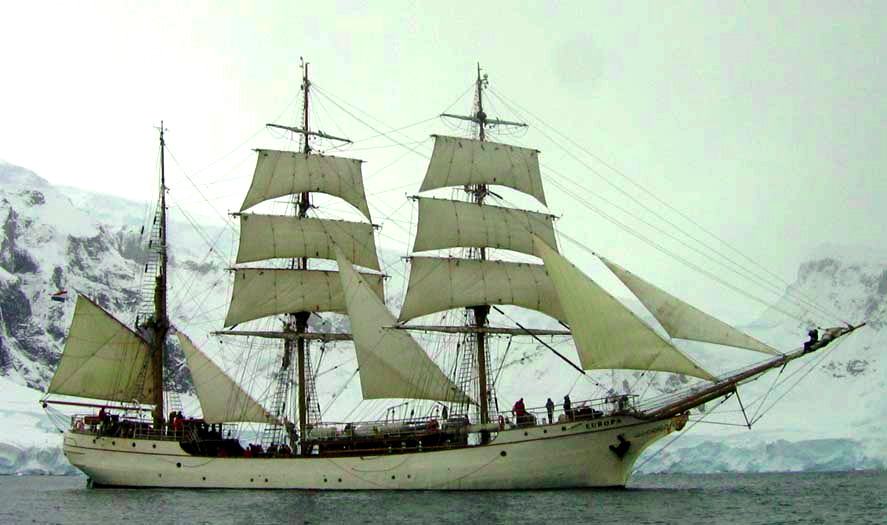
I’ve been looking at the voyages offered by Victory Cruises on the Europa which sails out of Ushuaia on Tierra del Fuego. It’s voyages include the Antarctic Peninsula, Falkland Islands and across the South Atlantic to Cape Town.
Would love to go on that – but it will have to remain on the wish-list!

I was particularly struck by the final lines of dialogue in the movie.

“You can’t run from the wind. You face the music and keep going.”
How true. Just like life!

The image, by Rod Thompson, appears on the website of http://www.victory-cruises.com organisers of tall ship sailings in Antarctic waters – including voyages on Europa.

Saturday, October 28, 2006

Reflections on the canal

‘I’ve no idea how the working boatwomen managed to crochet with hands chapped and roughened by the cold and wet.’

Elizabeth Bryant, lace-maker extraordinaire describes herself as a Jack-of-all-trades, Master-of-non, despite her ‘Master’ accreditation in Cabin Lace.
Over the years Liz has turned her hand to many crafts, glass etching, stained glass and painting, to mention a few. ‘At one time I sold Victorian Peg People in Liberty in London,’ Liz said. ‘Children with kites or hoops; ladies with parasols. I also made models of several well-known smugglers, as well as thatched cottages, oast houses and churches. I enjoyed researching the smuggling history of the south east of England.’

But when Liz and husband, Paul bought a share in a narrowboat, she read up about the lives and skills of the working boatwomen. ‘I felt it was really important not to let them die out unappreciated. The Waterway Craft Guild does a lot to keep the old canal skills alive,’ she said. And it was through the Guild that she applied to become a ‘journeyman’ in the craft of Crochet and Cabin Lace.
Liz says she was most surprised when she was accredited a ‘Master’ and now, despite her vision impairment, tries to be worthy of the title by spreading the tradition as much as possible.

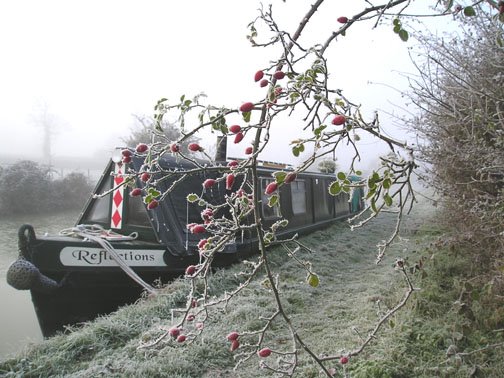
Today Liz and Paul have their own ‘project’ boat, Reflections. She says that when her husband has time from making double basses, ‘cellos and violas, they enjoy the beauty of the Inland Waterways.
The photo of Reflections was the one Liz used last year as a Christmas card.
It’s an ideal seasonal picture with the narrowboat crusted in a layer of frost. But Liz says, ‘Breaking sheets of thin ice on the canals is very musical, but frozen ropes hurt my hands. I’ve no idea how the working boatwomen managed to crochet with hands chapped and roughened by the cold and wet.'

Another article about Liz’s work was posted earlier. You can find out more about Liz and her lacework at http://www.englishcrafts.co.uk/
Also read about Paul Bryant, who 30 years ago taught himself to make violins. Today Paul specializes in basses and his instruments are found in many British orchestras.
http://www.bryantbasses.co.uk

Wednesday, October 25, 2006

White ensign flies in Nelson's memory


The Church of All Saints in Burnham Thorpe flies an 18th century White Ensign in memory of Admiral Lord Nelson who was christened there by his father, Edmund - the rector.
Nelson had written that he would expect to be buried there along with his family, but his final resting place after the Battle of Trafalgar was St Paul's Cathedral.
When raised to the peerage in 1798 Nelson took the title Baron Nelson of the Nile and of Burnham Thorpe.
Only one other church is Britain is permitted to fly the White Ensign and that is St Martin-in-the-Fields.

The excellent photo comes from author, Hester Devenport. Hester's biographies of both Mary Robinson (Perdita) and Fanny Burney are available at http://www.amazon.co.uk

Saturday, October 21, 2006

Trafalgar Day - 21 Oct 1805

What better day to read the final pages of Pockock's book, Trafalgar, than today - the 201st anniversay of that awful battle.
As the majority of his story is made up of letters written on board the British, French and Spanish ships immediatley prior to, or after the battle, the words are poignant - the descriptions of carnage of both men and vessel - unbelieveable.
Likewise, Nelson's last few hours spent below deck are reported in such a way one feels as though one is present at his passing.
And following the French defeat, Pockock writes of the gales which lashed the fleets for several few days, sinking many of the prizes and robbing the seaman of their hard earned rewards.
Ironically hundreds of those seamen and marines, who survived that most horrendous sea battle, died at the hands of the hurricane-force storm, uncerimoniuosly joining their mates in the deep.
I now wish I had read the book before visiting Victory this year.
I must go back one day.
Photo (M Muir): The Royal barge of Charles 11 (built 1670) carried Nelson's coffin along the River Thames. (Royal Navel dockyard museum, Portmouth)

Monday, October 16, 2006

Canal crafts - the skill of the boatwoman

What is this beautiful hand made item?
At a quick glance it could be an iced birthday cake.
No, you say!
Or a lace garter – elegant enough for a bride to wear!
Believe it or not, this is a pair or horses’ earcaps made in fine lace and decorated with brightly coloured tassels, the type crocheted by the boatwomen on the canals to keep the flies from the boat-horses’ ears a century ago.
On her website, Liz Bryant displays the crafts of the boatwomen who decorated their barges by trimming the shelves, portholes, chimneys and even their horses with lacework in various designs.
I find it sad that this sort of tradition, like the barges themselves, is dying and unlikely to return. Today, women’s hands are now occupied on production lines or keyboards, while few fingers learn to master a spinning wheel, a crochet hook or even a pair of knitting needles.
Having read about the skills of the boatwomen while researching my latest novel, I made sure the traditonal lacework was mentioned.
In my own defence, I can say that in my latter years, I learned how to spin sheep wool, alpaca fibre, cashmere and mohair and have made jumpers from my own wool.
I can tan a calf and goat hide and have made many a teddy bare and soft toy. I’ve even tanned a fish and snake skin.
And when my boys were growing up, I taught them both how to knit.
I wonder if today’s society has really progressed.
I don’t think most people could survive today without technology.

Elizabeth Bryant, an accredited Master of Crochet and Cabin Lace in the Waterways Craft Guild, continues this tradition, making crochet nets in a wide variety of traditional and original designs.
I thank Elizabeth for the image of the horse’s earcaps.
You can visit her site at: http://www.englishcrafts.co.uk/

Wednesday, October 11, 2006

Canal story - The Black Thread

Delighted to say that yesterday my latest manuscript was accepted by Robert Hale in London.

The Black Thread is a dramatic tale set on the Leeds and Liverpool canal and around the model-mill town of Saltaire in 1898.

I hope to see the book published by the middle of 2007.

For an insight into the background to the story, the British Waterways and the town of Saltaire, please visit my new site at: http://www.squidoo.com/theblackthread

Tuesday, October 10, 2006

Anne Whitfield - published author joins Hale stable


Hi everyone and thanks to Marg for having me as a guest on her blog. We share the same publisher in Robert Hale UK, but my first release with that publisher isn't out until Feb 2007.

I live in the beautiful Southern Highlands area of New South Wales, Australia. I'm married with three children and have strong ties with Yorkshire, England.
I write historical fiction, contemporary novels and short stories all of which are set in both Yorkshire and Australia.

My first historical novel - a USA release, is Kitty McKenzie set in York, Yorkshire 1864. Left bankrupt and in charge of her siblings' welfare, Kitty faces an uncertain future that tests her strength of character.
For more information about me and my books please stroll over to my website or blog.
My Website: http://www.annewhitfield.com/ Blogspot - http://annewhitfield.blogspot.com/

Wednesday, October 04, 2006

Reliving 'Trafalgar'


Me thinks its about time I went to sea again.

Would love to write another sea story.

Currently reading Tom Pocock's Trafalgar.

Having walked on the decks of Nelson's flagship, HMS Victory, makes the action, which took place at sea 200 years ago, come alive (see HMS Victory post last month)

Have also just ordered from Amazon, the first five books in the Hornblower series. I am looking forward to reading those - if I can't sail away, I can at least dream a little.

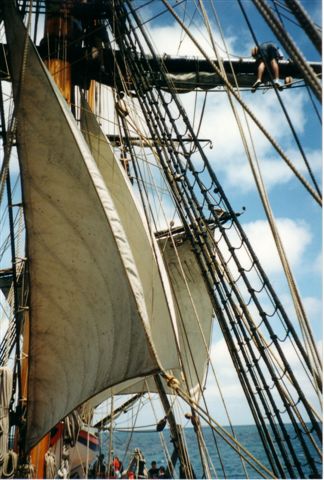
Photo: Setting sail on board HM Bark Endeavour replica in the Indian Ocean off Perth, Western Australia (M Muir)

Summer around the corner


October already!
Goats are happy and all the kids have grown well.
The grass and weeds in the garden have gown too well and need major attention!
Last week I sent off my latest manuscript and must now wait to see if it is accepted.
I'm waiting to receive copies of The Twisting Vine published 31 August - they've not yet reached Western Australia!
Also waiting on Ulverscroft large print copies of Sea Dust - also not yet arrived. I'm anxious to know what the new edition looks like.
Must start thinking about next novel and start work on it in a couple of weeks.
Must start planning a tall ship talk which I'm due to give to a Perth yacht club in a month's time.
Grandson coming to stay, so I guess all the above can wait for a few more days.

Thursday, September 28, 2006

Anaphylaxis in Goats?

Well I've seen many things in 17 years of goat farming, but yesterday was the first time I had seen an anaphylactic reaction in a goat.
Well, that was my estimation of what it was and I'm not a vet - so if anyone can correct me please do so.
The goat was in poor condition and as we are in a cobalt and selenium deficient area here in Western Australia, I gave her a vaccine of 3 in 1 with selenium and a 4 ml injection of B12.
I administered the injections subcutaneously.
Within about 5 minutes of the injection, the goat was hyperventilating (rapid breathing, her mouth was open, her tongue looked bluish and thick.
In all the reaction probably lasted between 7 - 10 minutes.
My assumption was that she had suffered an acute allergic reaction to one of the injections - most likely the B12 as I had exceeded the recommended dosage.
My immediate worry was that the reaction was causing her throat and tongue tissues to swell and her airways to tighten, as in a penicillin reaction or asthma attack.
My only thought for a solution was to give her some Ventolin by inhaler.
I administered four of five puffs into her mouth though I think most got blown out with her rapid puffing.
Whether my home-grown diagnosis was right or whether the home-grown treatment helped or hindered, I don't know.
If anyone can advise me, I'd be pleased to receive your comments.
What I do know is that the doe in question is alive and feeding today and no worse for her 'funny turn'.
Photo: M Muir - Pink and grey galah feeding on acasia in garden

Do goats grieve?

I believe they certainly do.
With the goats just kidded, I feel for the ones whose kid’s die for one reason or another. If/when it dies, the doe paws it and tries to get it onto its feet. She licks it, and at night she lays beside it. If you remove it then she will go around for two days looking for it and calling for it. It’s an easily recognisable call, quite plaintive.
But it’s not just newly kidded does who show feelings of loss.
Goats are very family oriented. They stay together and sleep together in family groups.
I sold some goats yesterday and didn’t realize I had sold the 3 previous years offspring of one six year old doe. She had a one year old, a 2 year old and a three year old..
Today she had been wandering around the paddock crying/calling and looking for them everywhere.
Don’t I feel like a real rotter.

Wednesday, September 27, 2006

Goats - the ballerina kid perhaps?

Perhaps I should be breeding performing goats?

Goats - kidding ends for another season


With the last kid born yesterday, that is the end of my kidding season for 2006.
A total of 19 new members to my small flock.
It was one of those seasons where lots of things didn't happen as they should but I won't bore you with the details.
Kids look good and most are at the stage of chasing around like a mob of little puppies.
We have a reasonable amout of feed on the ground, though the winter has been very dry and it started growing very late.
Will add more pictures later.

Saltaire - a remarkable town


Saltaire was built on the banks of the River Aire and the Leeds and Liverpool canal in the 1830s, It's founder, Sir Titus Salt, was an extraordinary man of vision and philanthropist.
It is said that in his lifetime he gave half a million pounds to charity (in the 1800s – that was a considerable amount of money).
Not only did he build a mill and town for his workers, but he provided everything for them including modern (in those days) housing, a hospital, churches, schools and recreation areas. But being a man of sober habits, he did not permit the town to have either an inn or a pawn shop.
Built in stone, Saltaire is designed in the Florentine style.
The Congregational Church (now the United Reformed Church), is an excellent example of Italian architecture.
Photo M Muir – Yours truly during a visit to the unique mill town

Saltaire - Goat and Alpaca fibre


From the 1850’s Sir Titus Salt was importing alpaca fibre from South America, and also mohair (which comes from angora goats) to add the luxury sheen and feel to his yarn.
Today Salt’s mill still uses these exotic fibres to produce its quality speciality cloths.

Photo: M Muir – The bust of Sir Titus Salt today stands in the entrance to the United Reformed Church (formerly the Congregational Church).
At his feet are an alpaca and an angora goat

Saltaire and 'The Black Thread'

I chose Saltaire as the setting for my latest manuscript, The Black Thread.
The title refers to the body of still water which runs across England – the Leeds and Liverpool canal.
It is a historical fiction novel set in 1898.
I completed the manuscript this week and have forwarded it to my agent.
I now wait with fingers crossed for the outcome.

Searching for an apt quote or verse to go inside the cover, I came across The Lady of Shallot by Alfred Lord Tennyson.
As I read it I found its content had some similarities my story:-
The Lady is alone and desperate.
She is on a barge (shallop).
It is being towed by a horse.
She is on her way to Camelot (a visionary town – just like Saltaire was).
She waves her hand and is known in all the land….

If The Black Thread is accepted for publication I would like the following verse from Tennyson to be included.

By the margin, willow veiled
Slide the heavy barges trailed
By slow horses; and unhailed
The shallop flitteth silken-sailed
Skimming down to Camelot:
But who hath seen her wave her hand?
Or at the casement seen her stand?
Or is she known in all the land,
The Lady of Shalott?

Photo: M Muir - Salt's New Mill and the L & L canal taken from the grounds of the United Reformed Church

Cruising Europe - first stop Rome

A bit belated, but here are a few pics from my recent trip to Europe.
I’m sure there are lots of you who have ‘done’ these destinations, and thought it would be nice to share memories.
How about ROME – I started and ended my cruising holiday there – three days in the Eternal City.
I visited so many places it hard to remember them all. Of course there was the Coloseum, The Trevi Fountain, The Spanish Steps and the magnificent modern war memorial. Even stood in the field of Maximus which is nothing more than a long oval expanse of grass – but that is where the chariot races used to be.
But I think for me the trip to the Vatican City was most awesome (see final post in this series). The artwork is absolutely unbelievable and there is just so much of it. The Cistine Chapel with it’s famous ceiling is just a drop in the ocean. St Peter’s Basilica is another awesome place and I was pleased to see that there was no cost to go inside.
A few things of practical interest for anyone going: I booked a hotel over the internet – easy peasy – and got one almost right outside the main Terminii station – that is just so handy for the metro and country trains.
Also if you are on a cruise don’t pay the ships cost for transort to Civitavechia – they’ll want and arm an a leg for it. The trains cost a few dollars – only proviso is that you can walk a few hundred yards at the other end.
Next stop Naples
Photo: M Muir - Arch of Constantine with the Coloseum on the right and the Roman Forum on the left (2 pillars showing)

The Colosseum - from the inside

If you have watched the movie, Gladiator, you wil remember other gladiators and a tiger appearing from below the arena.
I have to admit I thought that was a bit farfetched.
I now understand that it was the case.

Looking at the actual Colosseum you can see the maze of corridors and pens beneath the area itself.
An awesome place.

Photo: M Muir - Inside the Roman Colosseum - The area at the far end where the floor level has been recreated gives an indication of the maze below the area where gladiators and wild animals were housed.

Naples, Vesuvius and Pompeii

Cruise ships are great for getting you from one interseing place to another and I much prefer it to the hassle of airports. The only trouble is the time you have to visit the places of interest can be a bit limited.
However, the ship docked early in the morning in the port for Naples and I had booked to take the day tour which included climbing Mount Vesuvious and visiting Pompeii.
Vesuvius is a volcano which has blown its top on several occasions - the most well known when in destroyed the towns of Pompeii and Herculaneum in 79AD.
It looks pretty dormant today when you gaze down into the crater at the top, but I gather it is still classed as active in geological terms. The climb up was pretty long and tiring (hard work on dusty volcanic ash and rubble) but envigorating.
From Vesuvius it was down to Pompeii. This is somewhere I had always wanted to visit and had seen several documentaries about it on the TV over the years. I wondered if this would spoil it for me but it didn't.
The town is amazing and it is so big. Streets criss-crossing which in the first century had lots of shops (you can see the grooves in the doorways where the sliding doors were) and houses and public areas. The sanitation and drainage the Roman had puts the poor mediaeval Brits to shame.
Unfortunately, I didn't have time to go into the main museum which houses most of the best artefact, including the encased bodies of those who seccumbed to the ash, but there were a few at the site. What a terrible way to die.
I would have loved to have seen Herculaneum as that town is still being uncovered, but time did not permit so it was back to the ship for the two day cruise down to the Greek Islands.
Photo: M Muir - Frozen almost two centuries ago in volcanic ash - a falorn figure awaits its final resting place

Greece Islands - Mykanos

Cruising the blue waters of the Greek Isands is perfect. Theislands themselves are beautiful.
Mykonos brought back memories of Majorca and the holidays I spent there at El Arenal, back in the early 60s, when they were still building hotels on the beach front. It all looked so pristine and white against the azure sea.
The Greek town is a bustling fishing port where fishermen hang the squid they have just caught, on the boat's rigging to dry.
Dominating the bay are the unusual thatched windmills and in the town itself the small shops are hidden in a meshwork of narrow alleyways.

Greek Islands - Santorini

Santorini is quite different.
The group of islands on which it is located are actually the caldera of an active volcano.
It's like the town (and a few others) is sitting right on the rim of a teacup with an almost perpendicuar drop to the water below.
The only access to Santorina is by cable car or donkeys which zig-zag up the cliff.
I chose the cable first up to take in the fantastic views. The cruise ship looked like a toy from above.
Like Mykonos, Santorini is made up of white buildings many with rounded domes, amongst them, some beautiful churches.
The museum contains archaelogical relics going back to the 3rd Century (and probably older) and it is thought by some that this area - before the massive volcano blew it away - was the lost island of Atlantis.
With a whole day to wander around, I took a local boat tour to the island in centre of the bay.
Stepping ashore you are overawed by the towering mounts of ugly black solidified rock of a geolocically recent lava flow.
It's amazing to imagine that within our lifetimes this was red molten lava sizzling into the sea.
We were assured that the island is safe today but the vents puffing green sulphuric steam are a reminder that there is a lot of unbridled power lurking not far beneath the earth's crust.
For the ones who brought their bathers there was the chance to swim in the warm thermal waters. I missed out on that.
With a bit of time remaining, when we go back to the jetty, I decided I had to take the doney ride up the cliff.
In retrospect, as I hate height, it might have been a mistake!
Sitting atop a donkey which seems to want to take the side of the path nearest to the edge, had me regularly closing my eyes and hoping for the best.
Needless to say, I made it to tell the tale.
Santorini is a fantastic holiday destination which I would go back to tomorrow given half a chance.
Off to Scicily next.
Photo M Muir - note cuise ship below the town of Santorini and new 'active' volanic island behind it

Sicily


Steaming into the port of Messina in Sicily gives some indication of the character of the island which is best known for its Mafia connections and the its still active volcano, Mt Etna – the largest in Europe.
Overlooking the port is a golden statue (not sure if it’s Christ or the Virgin Mary – perhaps someone knows), while nestled against the wharf are three huge cruise liners. Further along there is a sailing jetty full of expensive modern yachts, but a little further along the harbour, a shipyard littered with partly sunken hulks.
Having climbed Vesuvius in Italy, I opted not to go up Mt Etna or take any of the other trips organised by the ship, so I spent the day wandering around the town.
The port city, like so many other port cities, is not a place I would recommend for a holiday but it did have some interesting building. Next to the cathedral is the famous bell tower. Rising 90 meters from the Cathedral square, it houses the larges animated clock in the world.
All the symbols and characters and astrological signs are in gold and at 12 noon for 15 minutes they ‘perform’ their show. Apart from the various gyrations and movements, the lion roars and the golden cockerel crows.
There is not a lot more I can add. It was Sunday and siesta time and everything was closed – that is off course apart from an Irish Pub across from the waterfront. As it was a very hot afternoon the beer went down very nicely, thank you.
Back on board for the cruise up to Cannes