Showing posts with label history. Show all posts

Thursday, January 04, 2007

Lost World of Sailing Ships 1780-1880


The above title is the subject of a Distance Learning (Internet) course offered by Exeter University in England.
It provides and insight into the maritime economy of the South West of England in the nineteenth century and looks at how the world of sail changed during that time.
Subjects included in the syllabus include:

Vessels: their categories and cargoes.
Mariners: their education and careers.
Ports: their rise and fall.
Shipbuilding and shipwrights:
Sailmakers, blockmakers, ropemakers: the role of ancillary trades.
Privateers: the last days of privateering.
Smugglers: the organisation of smuggling and its eventual control.

The one sememster (non-accredited) course commences in February and has no set assignments. For further info from the university's Distance Learning Department go to: www.education.ex.ac.uk/dll/
I'm pleased to say I am enrolled in this course.

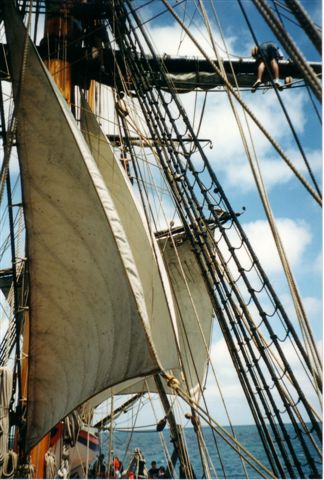
Photo: Europa - Victory Tours out of Ushuaia, Tierra del Fuego offering a 53 day sail in 2008 - Cape Horn to the Cape of Good Hope via Antartica.

All I need is about 8000 euros and a body 25 years younger - You can't stop dreaming, can you!

Tuesday, November 28, 2006

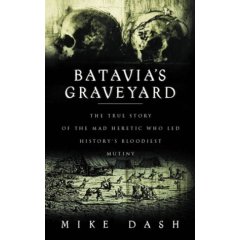
Batavia’s Graveyard – history’s bloodiest mutiny (1629)


Though Captain Cook is credited with discovering Australia, Dutch trading ships had been sailing a course parallel to the continent’s west coast for almost 200 years. Of those ships, several had been lost off the uncharted coastline.

Mike Dash’s, Batavia’s Graveyard, is the true story, told in narrative form, of the worst civilian maritime massacre ever recorded.

In the autumn on 1628, the East Indiaman, Batavia, the largest and newest ships of the Dutch East India Company’s fleet set sail from Holland loaded with a King’s ransom in gold, silver and gems. She is bound for Java on a route which carries her close to the coast of the yet uncharted continent of Australia.
On board is Jeronimus Cornelisz, who during the voyage plots a mutiny with the Captain and other members of the crew.
When the ship is wrecked and the Company’s Agent sets sail in an open boat to seek help. He leaves over 200 survivors on the islands without water food or shelter.
In order to secure his survival, Cornelisz seizes control and begins to systematically kill the survivors. Without tainting his own hands, he forces his henchmen to hack to death more than 120 of men, women and children.
Batavia’s Graveyard is no fiction story. It is a poignant and chilling true re-enactment of the events which took place.
And it is said that if you happen to land at Houtman's Abrolhos, the tiny uninhabited archipelago just off Australia's west coast today, you can still find the sun-bleached bones of the victims.
Evocative, unbelievable and certainly unforgettable.

Batavia’s Graveyard by Mike Dash (2002)

Monday, November 27, 2006

HMS Beagle (replica) - to sail again


The vision of the Beagle Project Pembrokeshire is build a replica of the three masted barque which carried Darwin on his epic voyages (1831-1836). She will be “built of larch on oak frames, the hull will be copper sheathed and the boat will be fitted with modern propulsion, navigation, safety and communications equipment.”
Like the 1830’s vessel, she will be equipped with the latest technology, “to allow aspiring and practising scientists to use her as a platform from which to collect specimens and on which to store samples and stage experiments". She will be an inspiration to a new generation of scientists.
And on her first major voyage (2009) she will circumnavigate the globe, retracing the voyage the Beagle took in Darwin’s day.
The original ship:
When the Beagle was launched on the Thames in 1820, she was brig-rigged carrying only two masts with square-rigged sails. Because this design of ship sat low in the water and had a habit of turning-turtle if mishandled in heavy weather, it was sometimes referred to as a ‘coffin ship’.
In 1825, however, she was re-rigged as a barque with the addition of a mizzen (third) mast fitted with fore and aft sails. This configuration made the ship more manoeuvrable.
When HMS Beagle was commissioned in 1831 to continue survey work in the Southern Ocean, she was again refitted under the direction of Robert FitzRoy, her captain, who ensured she benefited from the latest in nautical technology. For example, for the first time in a Royal Navy ship, lightening conductors were fitted to all the masts.
At 235 tons, the Beagle’s masts and spars were extra strong, and chains had been used in place of ropes where possible.
It was under the command of skilled navigator and surveyor, Captain FitzRoy, the ship carried the young naturalist, Charles Darwin on the voyages which were to lead to his theory of evolution.

For more information on the Beagle Pembrokeshire Project go to:
The Beagle Project.

Photo (M. Muir - HMS Endeavour replica)

Friday, November 24, 2006

The Beagle Channel - revisited


There are still places in this world where you stand in awe.
Where there is an aura of solemnity.
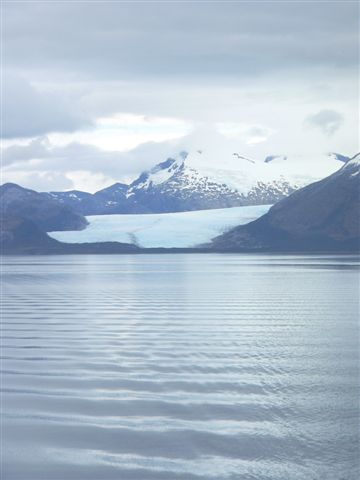
The Beagle Channel is one of them - and it is something you don’t expect when you just around the corner from Cape Horn.
Apart from its stark beauty, what struck me about it was its solemn stillness.
Glaciers and ice make little sound.
New-fold mountains sleep, their great stubbled chins pointed skywards while above them condors the size of worker bees wheel in effortless in silent circles.
A thousand streams and waterfalls glisten as they slip relentlessly over honed rock faces only to disappear in the wooded banks below.
Penguins and occasional whales grace the water, while on the scattered rocky outcrops, seals wallow unperturbed while on tiny islands innumerable cormorants hold out their flaccid wings to dry.
Beneath the crystal waters, tall weeds wave their golden fronds as the small boat passes above them leaving barely a ripple on the surface.

The Beagle Channel stretches 120 miles long and two miles wide, and Charles Darwin likened it to the valley of Scotland’s Lockness.
In his words:
The lofty mountains rise to a height of 3,000 and 4,000 feet…covered by a wide mantle of perpetual snow, and numerous cascades pour their waters through the woods, into the narrow channel below. In many parts, magnificent glaciers extend from the mountainside to the water’s edge. It is scarcely possible to imagine anything more beautiful than the beryl-like blue of there glaciers and the dead white of the upper expanse of snow. (The Voyage of the HMS Beagle).

The Channel is probably unchanged since the time HMS Beagle made its first passage in the 1830s and it will be that same scene which will greet the replica ship when she sails south in a few years time.
Thanks to Peter Grath, I have just learned of the Beagle Project Pembrokeshire,
Zoologist, Peter, and David Lort-Phillips director of the Darwin Centre for Biology and Medicine in Wales are co-founders of the project to build a replica of the Beagle.
For more information on this project go to:
The Beagle Project.