Monday, August 28, 2006

Goats - Ten kids so far

This morning was freezing and the tenth kid was born at 6 am.
There are two sets of twins so far and all doing well.
I took this picture a few years ago when I was running about 150 angora goats.
Angora goats produce mohair.
Angora rabbits produce angora fibre.
Mohair is a fibre - it's not wool or hair.
It is called the diamond fibre because of its lustre.
I loved the angoras but unfortunately they needed shearing twice a year and at one stage, with the cyclical price of mohair, it was costing me as much to get them shorn as I was getting for the fleece.
I gather now the price is up again - $30 to $50 a kilo for kid fibre - that's how the market goes. (Note: a good quality adult can shear 6 kilos of fibre)
The goats I have now are South African Boer goats which are bred for meat - though I don't eat them, I sell them on for breeding.
I'll have some update pictures of Boer kids later.
Photo: M Muir - Angora kids - Western Australia (c. 1996).

Friday, August 25, 2006

Goats – Associated with God or the Devil?

While goats, particularly in the Middle Ages, were maligned as being agents of the devil, they have long been providers of food (meat and cheese), milk, skin and fibre (mohair and cashmere) products, and in many countries of the world are still major providers or food and income.
I, for one, have run goats for their fibre, meat and companionship for 17 years (about the same time as I have been writing – there must be a message in that somewhere – but I’ll get back to that later).
I found it interesting reading the following on a Mediaeval Bestiary website:
The goat's love of high mountains represents Christ, who also loves high mountains, that is, the prophets, angels and patriarchs. As the goat feeds in the valleys, so does Christ in the church, where good works are his food. The sharp eyesight of the goat shows the omniscience of God and his perception of the tricks of the devil.
I also like, The Prayer of the Goat

Lord, let me live as I will
I need a little wild freedom
A little gladness of heart
The strange taste of unknown flowers
For whom else are your mountains?
Your snow, wind? – These springs?
The sheep do not understand as they graze
All of them and always in the same direction
And then eternally
Chew the cud of their insipid routine
But I – I love to bound to the heart of your marvels,
Leap your chasms
And, with my mouth filled
With intoxicating grasses
Quiver with an adventurer’s delight
On the summit of the world.

Poem: Translated from the French by Rumen Goddem
Bestiary website referred to: http://bestiary.ca/beasts/beast163.htm
Photo: M Muir – Bakers Hill, Australia

Goats – The Isle of Capri

Some scholars believe that the Isle of Capri gets its name from the Latin word Capreae (goat) while others argue it is from the Greek, Kapros (wild boar).
Being a lover of goats, I like to think it is the former.
Nestled, in the blue waters of the Mediterranean, off the coast of Naples, the Isle of Capri is a large rock. Its steep cliffs soar almost vertically from the waters.
This magical island, which has long been synonymous with idyllic holidays and romance, certainly has magical qualities. It is splashed with the colour of hundreds of different flowering plants, and it is fragrant with their perfume, all year round.
It is said when you view the island lengthwise, it takes the form of a sleeping woman – her abundant long-flowing hair waving back from her head, her face, her breasts and her body lying naked on the sea.
I sailed past Capri as the sun was setting behind it.
Can you make out the shape of the mystical woman?
Photo: M Muir – July 2006

Wednesday, August 23, 2006

Goat update - New kid on the block!

Well, the goats haven't had a mention for a while, so the arrival of the first kid about 2 hours ago will change all that. Expecting another 25 or 30.
Will post a few photos and let you know how the kidding goes.
Reminds me of a couple of other goat items I should have mentioned.
Photo: M. Muir - First kid for 2007 - Full blood Boer

What a week!


It's been a great week.
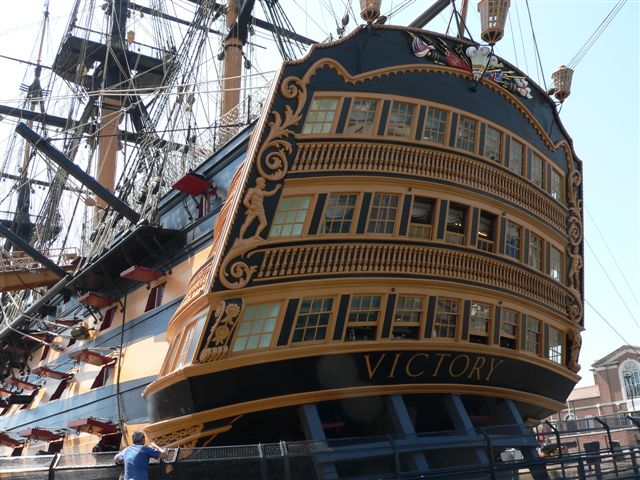
Today I saw a copy of the jacket cover of the large print edition of SEA DUST. Interesting - the stern of the ship looks liitle of HMS Victory (posted earlier) whereas the ship in the story is a mid nineteenth century barquentine.
Close enough though!
Also today, I picked up my author copies of THE TWISTING VINE from the post office.
I'm delighted with the final production. My compliments to Mr Hale and his staff.
Last but not least - the first of my goats just had a kid - and it's a doe. That's a good start. The rest will all follow within the next two weeks. I could end up with 30 kids.
Image: Sea Dust - Ulverscroft Large Print edition

Thursday, August 17, 2006

Fenella-Jane Miller - Regency author

Though her current work in progress is set in WW11, Fenella-Jane Miller is best known for her Regency novels. Recently, she decided to take a break from writing in the Regency era. She feels it is always possible for authors to repeat themselves.
On 31 August, her latest book, A Dissembler will be published, and the following day, LP Thorpe will reprint, The Unconventional Miss Walters, her first novel, in large print format.
Her other novel published by Hale in March, was, A Suitable Husband, and, coming up in February next year, is her next Regency title, The Mesalliance.
Living in an ancient cottage in an idyllic country setting is the ideal location for an author. And the part of Essex where Fenella lives is steeped in history. Local names and places sometimes pop up in her stories.
‘I have already sent photographs of St Osyth Priory to the artist, David Young, who creates my book covers,’ Fenella said. She is delighted with his work especially the jacket cover for, A Dissembler, and is looking forward to receiving his next rough sketch.
Apart from her three novels published by Hale Books, Fenella has written for DC Thomson’s, My Weekly Story Collections.
She has one long novel, set in England and India, partially based on her mother’s memories, which is almost complete.
Fenella has worked in various jobs, including a nanny, secretary, restauranteur and school teacher, but she always longed to be a professional writer.
Having achieved that goal, Fenella now writes every day, first drafting her manuscript by hand before transcribing it into the computer.
She has two children and two grandchildren and lives with her husband, Dusty, their border collie called Zoƫ,, and Tigger, an arthritic cat.
To read more about Fenella and her books go to: http://http://www.fenellajanemiller.co.uk/
Photo: M Muir – July 2006

Friday, August 11, 2006

Ancient religious book found in Irish bog

Hailed by the National Museaum of Ireland as the "Irish equivalent to the Dead Sea Scrolls", the discovery of an early Christian psalter that appears to date back as far as AD800 is the "greatest find ever from a European bog".
The ancient religious manuscript was discovered two weeks ago in a peat bog at Faddan More, in north Tipperary.
Further excavation of the site also uncovered a fine leather pouch in which the manuscript was originally kept, as well as other small fragments.
It was considered that the book may have been deliberatley hidden in the peat all those centuries ago.
The large format manuscript comprises about 20 pages and appears to be of an Irish Early Christian Psalter, written on vellum.
One page, which was open when it was found, is still legible.
Psalm 89 is set out with 45 letters per line and a maximum of 40 lines to the page.
This find is not the first from the area - six years ago, a leather satchel was unearthed in the same bog. That has been radiocarbon dated to between the seventh and ninth centuries AD. Two ancient wooden vessels were also discoverd in the bog in recent years.
The area around Faddan More bog is rich in medieval history with the foundation sites of several monastaries located nearby.
Dr Pat Wallace, the National Museum's director said that the rare find: “testifies to the incredible richness of the early Christian civilisation of this island and to the greatness of ancient Ireland." She described the find as being of staggering importance.
The psalter will now be subject to a long and painstaking process of restoration,
Source material and photo: The Irish Times, The Irish Examiner and The Guardian

Tuesday, August 08, 2006

Barge building yard uncovered

John Constable (1776-1837), probably England’s most famous landscape artist, grew up at his father’s Flatford Mill not far from Dedham.
Constable lived in the heyday of the waterways when heavy cargo in the area was transported by Stour Lighters or barges. And at his father’s dry dock, the young man would have watched the wrights building and restoring the barges which serviced the mill along the River Stour.
It was his early sketches of lighters passing through the locks, and of boatmen and their boat-horses which were the inspiration for many hi famous works.
‘Boat-building near Flatford Mill’ (Constable - oil on canvas - 1815) depicts a barge sitting in Flatford Mill’s 18th century dry-dock.
Until recently this boat lock had disappeared - covered over by tons of earth.
When it was discovered in 1985 and excavated by the Stour River Trust, the dry-dock was uncovered, together with a barge which was still lying on the original timber supports.
As part of the restoration work, the Trust rebuilt the dock gates and steps (near front left in picture) using Constable’s detailed sketches.
Wandering the area a few weeks ago, I noted that Flatford Mill and Bridge Cottage, Granary Barn and Willy Lott’s house all attracted much attention, but few visitors took interest in the remnants of the dry-dock which was so significant in Constable’s life and paintings.
Photo: M Muir – July 2006

Constable Country

The setting which inspired Constable's painting - The Haywain
Photo: M Muir - July 2006

Monday, August 07, 2006

A mouse on the canal bank!

Though I love tall ships, I find canals and their boats intriguing.
I have to admit I’ve never travelled on one but I made a point of seeing quite a lot during my recent visit to UK as research for my current novel.
The SS Great Britain (see blog below) is situated adjacent to the Bristol Dock Navigation which is at the end of the Avon and Kennet Canal. Midway along that waterway is Hungerford and the village of Kintbury, where I spotted ‘Tittlemouse’ , a narrowboat, no doubt named after the Beatrix Potter character.
As with this boat, most owners take immense pride in their vessels keeping them clean and freshly painted and decorated with the traditional roses and castles designs. Many also have a colourful display of pot plants decorating the cabin roof.
And it is the Avon and Kennet which also boasts the most spectacular series of rises in England at Caen Hill (below).
Visit Granny Buttons at http://www.grannybuttons.com/granny_buttons/ for a picture of the SS Great Britain (5 August) taken from the waterway at Bristol
Photo: M Muir – June 2006

Caen Hill's amazing 29 locks

If you were driving through to Devises near Rowde, you could easily pass the Caen Hill locks if you didn’t know they were there.
I thought Bingley’s five rise on the Leeds/Liverpool canal was remarkable but the 29 locks which make up this flight are amazing.
The series were built between 1794 and 1810 to lift the Kennet and Avon canal a height of 237 feet.
Though it’s original use was superceded by the railways in the early 1900s and eventually fell into total disrepair, restoration work thrity years ago has not only restored, but improved the system of locks. Today the Caen Hill locks are a popular and busy canal for recreational boaters.
Gazing up the 16 locks which form a straight line, one has to consider what an amazing feat of engineering it was 200 years ago.
Note: I will be writing more on the Leeds/Liverpool canal as time goes on especially the Leeds to Saltaire section. For more on this area visit: http://www.penninewaterways.co.uk/
Photo: M Muir - June 2006

Thursday, August 03, 2006

SS Great Britain - Bristol


I visited the SS Great Britain in Bristol a few weeks ago.
This extraordinary ship was designed 1839 in an era when square rigged shipped sailed the seas, and when Admiral Lord Nelson and Trafalgar (see postings below) where still imprinted on men’s memories.
Prince Albert Launched the SS Great Britain at Bristol in 1843, the same year Charles Dickens published, ‘A Christmas Carol’.
This monster ship was the brainchild of Isambard Kingdom Brunel and its construction was set to change the history of shipping. Here was an enormous iron-hulled ship that not only had a powerful 1000 horsepower engine and propeller (quite different from the paddle steamer type of propulsion), but also was rigged as a schooner with six huge masts. She was the first of the great ocean-going passenger liners.
Her first crossing from Liverpool to New York was in 1845 took 14 days.
In 1852 she began carrying emigrants to Australia in a time of 60 days.
The SS Great Britain even carried the first England cricket team down under, in 1861, and between 1856 and 1857 she carried troops and horses to fight in the Crimea.
In 1881, the ship was sold. Her engine was removed along with two of her masts and she was turned into a sailing ship, converted to a Windjammer – three masts carrying square rigged sails and staysails.
She battled the Horn numerous times on her way to San Francisco and circumnavigated the globe 32 times in her career.
But by the outbreak of World War 1, this once magnificent ship was being used as a coal supply ship. Soon after the war she was scuttled and left to rust away off the Falkland Islands. There she stayed for over thirty years.
The plan to salvage her, to bring her back to Bristol and restore to something of her former glory was a bold mission. The man responsible was Ewan Corlett, a naval architect.
After towing the hull home over 8000 miles of treacherous seas, the SS Great Britain returned to the very dockyard where she was built exactly 127 years before.
At last, in 2005, after years of painstaking reconstruction work, this remarkable ship was ‘re-launched’.
As a visitor, stepping aboard the SS Great Britain, dubbed ‘one of the most important historic ships in the world’, is like stepping back in history.
You can walk through the first class saloons, see the bunks of the steerage passengers, wander the promenade deck lit by numerous slatted skylights from the deck above, even see the heads (inside toilets) and the gaol.
Perhaps one of the most amazing sights is the main yard which carried just one of its billowing square sails. This single yard (which sat horizontally across the main mast), is 100 feet long and weighs 7 tons.
With passengers and crew totalling around 500 souls, the ship had to carry enough fresh stores to cater to the passengers needs.
On a voyage in 1864 supplies included the following live animals - 1 cow, 3 bullocks, 150 sheep, 30 pigs, 500 chickens, 400 ducks, 100 geese and 50 turkeys not to mention all the hay and grain to feed the livestock to keep them in prime condition for the voyage.
If you scroll down a couple of posts and you will see a picture of the ship’s elegant dining room and find a further comment about the ship.

Sunday, July 30, 2006

Hester Davenport – Biographer

Connections with kings and courtesans, marine luminescence and the 'Mary Rose'.
The more I get to know Hester Davenport, more coincidences crop up in things we are both interested in.
We met initially over the internet when I was searching for information on Lady Florence Dixie. I found an article written by Hester in a journal published in Windsor and discovered she was quite an expert on this Lady.
From here I discovered that, like myself, she was a published writer - a biographer, though her first published book (Puffin) was a series of unsolved mysteries for 9-13 year olds.
Hester's first biography, Faithful Handmaid: Fanny Burney at the Court of King George 111, was published by Sutton, in 2000, and reprinted in paperback in 2003
Her second biographical work, The Prince’s Mistress: A life of Mary Robinson was released in 2004. This has also been published in paperback (2006), a testament to her remarkable research skills and fine writing. (Hester holds an MA in Victorian Poetry.)

While I was in Old Windsor, Hester took me to see Mary Robinson's grave. It is in the local churchyard - just a short walk from where she lives.
Perdita/Mary Robinson, born in 1758, was hotly pursued by George, the 17-year-old Prince of Wales, after a royal command performance, at the Garrick Theatre, in which Mary Robinson took the part of Perdita in, "The Winter's Tale" .
Recently Hester published, Writers in Windsor. In it she includes such notables as Chaucer, Shakespeare, Dickens, Hardy, Tennyson, and of course Fanny Burney and Mary Robinson.
Currently she is casting around for another subject.

During the short time we spent together, I told her I had visited the Mary Rose and was amazed to find that she had been a volunteer speaker for the Mary Rose Trust. She joined the organisation in 1982 about the time the Mary Rose was raised and lectured about the ship for the next 5 years.
The other strange mutual interest we discovered he had was in marine bioluminescence.
But I will blog about this later.
And only today, I learned Hester owned an antique doll with blue glass eyes. My forthcoming novel features an antique doll with blue glass eyes.
Unlikely, but pleasant coincidences.
Hester Davenport's books are available from http://www.amazon.co.uk/
Photo: M. Muir July 2006 – Hester Davenport and Mary Robinson's grave at the church of St Peter and St Andrew in Old Windsor.

Saturday, July 29, 2006

Royal Naval Dockyard, Portsmouth


If you love ships or history, promise yourself that one day you will visit the Royal Naval Dockyards At Portsmouth, England.
There you'll see Nelson's ship, HMS Victory, you'll walk the decks and find the spot where Nelson fell. You will see the Mary Rose and learn about her service at the time of Henry v111, and you will step onboard the mighty Warrior and feel as if you have stepped back to the 1800s.
In the following blogs, I have given a small insight into each of these vessels.
I was blown away with what I saw.
I hope you will enjoy reading just a tiny sampler about each.
Photo: HMS Warrior from the Hard at Portsmouth.

Thursday, July 27, 2006

HMS Mary Rose

There has long been a rumour that Henry V111’s ship, the Mary Rose sank on her maiden voyage.
This is not true.
Launched in Portsmouth in 1511, from 1512 to 1514 she faught the French in the English Channel off Brest and Cherbourg.
In 1513 she was engaged against the Scots off Newcastle
During the second French Wars, 1522 to 1525, she was again fighting at sea, and it was when she was about to sail against the French, in 1545, that she sank not more than two kilometres from Portsmouth harbour.
There she sat for well over 400 years, her keel and starboard side encased in a protective layer of Solent silt.
The Mary Rose was lifted to the surface in 1982 from which time restoration work has been ongoing.

To visit to the Royal Naval Dockyards at Portsmouth to take in the sheer magic and majesty of the three vessels housed there (The Victory, The Warrior and the Mary Rose), to ingest all the information available, is wishful thinking.
I left my viewing of the Mary Rose to last, I suppose because the shed she is housed in is not as inviting as a two tall ship sitting in a dock in front of you.
Now I wish I had had given myself more time.

Consider the Mary Rose, a purpose built warship, built almost entirely of oak.
Consider life on board in the early 1500s – as revealed by the thouseands of artefacts brought up with the ship.
Consider the men who sailed her – the mariners who earned 6s 8d a month (1545).
Consider the perilous tides and currents of the Solent which can toy with today’s vessels, vessels equipped with the latest in navigational equipment. For any ship to sail in and out of these waters was a feat all of its own.
When the Mary Rose went down, for as yet unknown causes (though several have been postulated), she took most of her crew of 385 (at least) with her.
The remains of 200 of these men were uncovered within the wreck, the majority being healthy young men in their late teens or early twenties.
Note on photo: Though I tried to photograph the ship though the Perspex walls and treatments mists of its sealed environment, my attempts were unsuccessful for reproduction here. I have therefore taken the liberty of photographing the ship from the Mary Rose, Museum and Ship Hall book, which I purchased during my visit.

HMS Warrior - Britain's finest warship


It’s quite possible that when HMS Warrior was launched at Blackwell in 1860, the event may have been witnessed by an old seadog who had served under Nelson on the Victory.
Imagine his amazement at the changes which had taken place in ship design and construction in only 50 years.
From wooden hulled fighting ships like HMS Victory to an iron framed, armour plated warship equipped with both sail and steam and driven by a propeller. The Warrior could sail before the wind under her 48,400 sq foot of sail or head into the wind, its 10 boilers and four furnaces operating at searing temperatures to power its huge engine.
Its two massive funnels were telescopic and could be cranked down when steam was not required.
Its four 5.6 ton anchors at both bow and stern, each needed 100 men on a capstan to raise them.
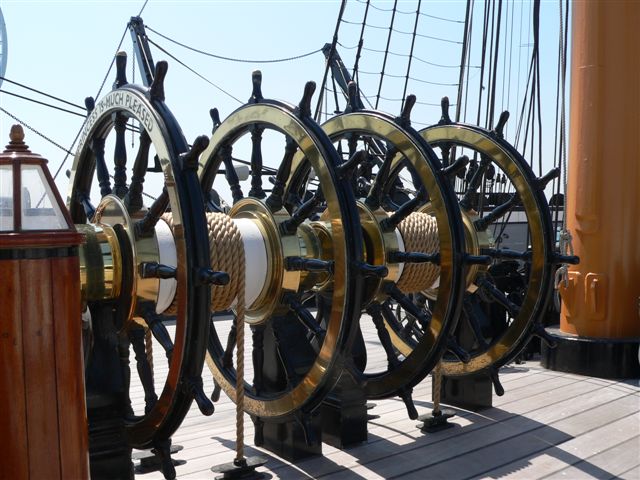
It’s 4 wheeled helm (as in the picture) which at times needed 16 men to hold the ship on course.
A speed of 13 knots under sail and 14.5 in steam.
A crew of 700 men now dressed in the uniform of the Royal Navy.
But perhaps most of all to its fighting power:
Twenty six 68 pounder muzzle loading guns
And ten breech loading 110 pounders.

Stepping on the Warrior’s deck, and wandering through the massive ship, is like taking a step back in time.
Having the opportunity to do that is thanks to the Warrior Preservations Trust and the men who rescued her from the scrap yard on more than one occasion in her life.

Sadly, HMS Warrior’s days of glory were few.
By 1870 masts and yards had become obsolescent.
She had served as Britain’s finest warship for only 10 years.
For the next 100 years she found service only at the bottom end of the maritime ladder.
But in 1979, with her hull still intact, she was taken to Hartlepool for restoration. Eight years later, surrounded by a flotilla of small ships, the newly restored warship was towed to the Royal Naval dockyards at Portsmouth, where she stands today – a tribute to the shipbuilders of the mid 1800s.
Photo: M. Muir – The Warrior’s mighty helm

The SS Great Britain - Magnificent cruise ship


On my recent cruise of the Mediterranean, I had a wonderful time and visited some wonderful places. The ship I travelled on was approximately 70,000 tonnes and was American owned.
The service was excellent.
The cuisine was excellent.
The staterooms (cabins) were excellent.
The only thing I could fault the ship on was its internal decour.
It was dull and at times rather jaded-looking.

Consider the dining room in the above photo.
This was taken inside the SS Great Britain - a cruising ship built in 1843.
I accept that she has been refurbished but the layout, with its marble pillars and sumptuous furnishing, reflect on the luxury of sailing first class in the mid nineteenth century.

More on the SS Great Britain on a later blog.
Photo: M.Muir - SS Great Britain - Bristol

Tuesday, July 25, 2006

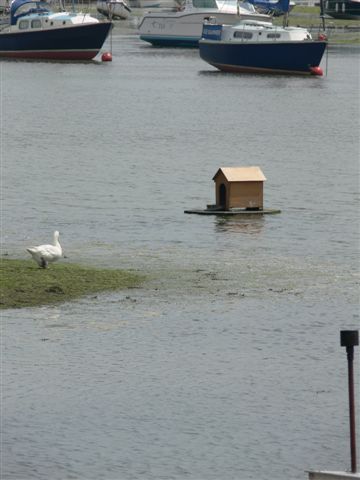
Sea dogs????


I've heard of old sea dogs!
But the sight of a dog kennel floating on a river in the Isle of Wight left me scratching my head!

Photo: M. Muir July 2006

Monday, July 24, 2006

Nelson’s ship ‘Victory’

A couple of weeks ago I stood on the deck of HMS Victory and gazed down at the plaque which marked the spot where Nelson fell.
So immense was the impact of the great ship, I had to wipe the tears from my eyes.
I can honestly say I have never been so awed by a tall ship in my life.
The sheer size of Victory is amazing. The length of its decks, the number and size of its guns.
And below decks the area where the everyday life of the ship was conducted: the quarters, the cabins, the sickbay, the huge staterooms – one Admiral Lord Nelson, another other for the Captain Hardy; the furnishings, including the original round table used by Nelson in his day cabin; and a replica of his hanging cot with its delicately hand-embroidered drapes.
Launched from the Chatham dockyard in Kent on 7th May 1765, it is said that Victory was then more ornate than she is today.
That is hard to believe!
She carried a crew of 850 and a complement of 104 guns including two 68 pounder carronades, and remained in service until 1812.
At 3500 tons, this formidable fighting machine could sail at a speed of 11 knots under a spread of 37 sails.
What a sight she would have been!
Victory was brought to her present berth at Portsmouth’s Royal Naval Dockyard in1922 where she stands proudly as the centre piece of a remarkable collection of true nautical heritage.
To one side she is flanked by the HMS Warrior – Britain’s first and last iron hulled warships (1860) – on the other, the remains of King Henry V111’s ship, the Mary Rose (1510).
I will write more on these in a later entry.
If I had seen nothing else on my visit to England, I would have been satisfied in having visited this magnificent ship.
Over 33 million visitors have trodden Victory’s decks before me and I am sure most will have left with feelings similar to my own.
If you love tall ships or history, a visit to the naval dockyards at Portsmouth is a must.

More info at http://www.hms-victory.com/
Photo by M Muir

Saturday, July 22, 2006

Visit to Hale Books, London


Situated in Clerkenwell, Robert Hale Limited is close to Fleet Street and is situated not far from the area of London which was once the hub of the British publishing industry. Today, I learn, much of the work is decentralized.
This is the case with Hale Books.
As one of their 'overseas' writers, I could not resist a visit to the publishing house which has accepted me into its stable of authors.
Hidden behind a row of tall trees, Clerkenwell House, a building which once accommodated much of the book production and distribution for the company, is now mainly sublet as offices. The bulk of the actual book production/printing is done outside The City.
Today, Hale's offices take up the fifth floor of the building offering striking views across the rooftops to the dome of St. Paul's Cathedral.
Meeting Mr Hale was a highlight of my visit to England. The fact he said that he wanted some more work from me inspired me to get back home to continue writing.
At Hale, I also met members of the editing and production staff who until now had only been names on the bottom of emails. It's so much nicer to be able to put face to a name.
Before I left, Mr Hale gave me a copy of the cover of my next novel, The Twisting Vine.
This, my second novel, is a fast-moving Yorkshire saga.
It is set in the period 1895 to 1920, where peace and war, joy and grief, are linked by the unobtrusive presence of a French Bru doll.
The Twisting Vine is due for release in hardback in England on 30 August.
Cover art - The Twisting Vine by Margaret Muir - Jacket illustration by Barbara Walton

Pompeii, Pontefract and back to Perth

What a whirlwind!
It's amazing what one can pack into five weeks.
I've seen unforgettable sights, been to amazing places, met wonderful people and gleaned some great background material for future books.
It's impossible to rate one visit over another but The Vatican City and its art treasures, Pompeii, and Nelson's ship, Victory, seem to vie for the most attention in my memory.
Over the next few weeks, I'll be blogging about some of the other ships I've seen including the SS Great Britain and King Henry V111's, Mary Rose.
I'll introduce two of the writers who I met while in the UK, historical novelist, Fenella Jane Miller, and biographer, Hester Davenport.
For those interested in holidays afloat, I'll take you back over the cruise I took which included stopovers in the major tourist ports in Italy, Greece, and the South of France.
Though my home is Australia, my roots are in England, so naturally I enjoyed visiting family and revisiting old haunts.
Whitby, where my previous novel, Sea Dust, was set, was high on the list.
So was Saltaire, the town where my work-in-progress is located. The locks and canals of the British waterways were of interest as they also play an significant role in the story.
Ilkley and the Yorkshire Moors were on my list as they feature in, The Twisting Vine, my next novel, due out next month.
That was the only day it rained during my holiday. The Yorkshire Moors looked bleak as usual.
I sailed to Cowes in the Isle of Wight, flew over Watership Down, and ambled around Flatford Mill near Dedham where John Constable captured the beauty of the English countryside.
Finally, a visit to meet my publisher, Robert Hale Ltd in London was a highlight.
It was an unforgettable holiday - but I am glad to be home.
Photo: The Thames, London, July 2006 - Robert Dunn

Wednesday, June 14, 2006

Ashes to Ashes, Dust to Dust

PJ and I met on a ship on the Indian Ocean.
We shared a love of the sea, of writing and of travelling.
In the two and a half years we were together we sailed on the Mediterranean, cruised the Indian Ocean and the South China Sea. We crossed the Atlantic on a clipper and flew across the Pacific three times. We even voyages through the Southern Ocean, crossing Drake Passage to witness the awesome beauty of the Antarctic Peninsular.
What a wonderful time we had together.
What memories!
PJ said that if anything happened to him he wanted his ashes to be scattered in the sea from the deck of a cruise ship.
Next week I will fulfil his wish as, with my son, I join a cruise ship in Civitavecchia (Rome) and sail out into the Mediterranean to say my final farewell.

Peter J Ryan - RIP
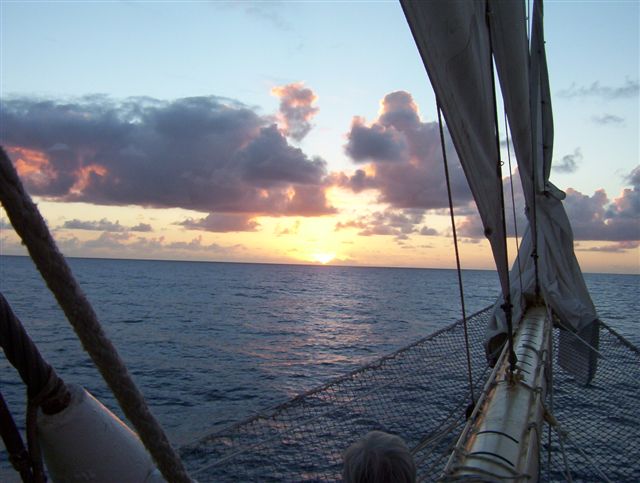
Photo: From the bow of the Star Clipper, Mid Atlantic 2004

Friday, June 09, 2006

SEA DUST - the romance of the sea and tall sailing ships


The following review of my novel 'Sea Dust' appeared in the Historical Novel Society's May journal. Reviewer, Fenella Miller wrote:

This is a well-written and interesting book which has been impeccably researched.
The vivid descriptions of Victorian Whitby, and ship board life, bring the places alive.
The author makes you feel as though you are walking through the streets and can actually smell the fish entrails and the body odours of the poor folk you pass.
The ship-board scenes make the reader understand what it is that draws men to the sea despite its dangers.
In this book the characters seem less important than the sea, the ship and the places. It is like looking through a window into the past – catching glimpses of emotions and events but remaining outside, not becoming involved.
Sea Dust is a love story, but not between the main characters, that is peripheral, it is about the romance of the sea and tall sailing ships.
This novel will appeal to anyone who has an interest in things maritime and a love of the past.
Ref : http://www.historicalnovelsociety.org

Saturday, May 27, 2006

Lost Lady of the Amazon

Unbelievable Amazon adventure
I have looked longingly at a voyage on a cruise ship up the mighty Amazon and added such a trip to my wish-list.
But imagine that journey in a rowing boat, battling the current all the way to the Andes. A voyage of 2700 miles that would take two thirds of a year.
And set the date in the 1760s! (Cook hadn't even set sail for Australia) - Remarkable!
Anthony Smith's narrative on the factual story of Isabela Godin includes Isabela's epic voyage from the Peruvian Andes in 1769.
''The Lost Lady of the Amazon is a true adventure story which any historical novelist would give his/her right arm to have thought of.''
I jotted down that statement when I was half way through Smith's book.
Then when I reached the chapter titled, Stranger than Fiction, I read the letter Isabela's husband had written to his friend telling him about her ordeal and saying that if you read it in a novel then you would ''accuse the novelist of not being true to life''.
His words were written in 1770.
Here is the Amazon.co.uk synopsis:
The French scientific expedition that set off for Peru in 1735 did not have much luck. Five of its members died or went insane before their seven years' work was completed, but Jean Godin, the youngest member of the team, fell in love with and married a local girl - Isabela, the daughter of the local Spanish governor.
After a few years, Godin crossed the Andes and travelled the Amazon to test whether it was a route suitable for his family. Unfortunately, having safely reached Cayenne in French Guiana, he discovered the political situation prevented his return...After almost 20 years, the King of Portugal sent a boat to retrieve the family.
Isabela at last set off with her children, her brothers and her servants, over the Andes and down the Amazon, but the journey was to prove worse than the waiting. Smallpox, starvation, the torrential river and the horrors of the jungle beset the travellers. Some drowned, some ran away, others died of hunger.
In the end, Isabela alone survived of the 42 who set off - she was found wandering in the jungle sick and half-crazed.
The Lost Lady of the Amazon - is an unbelievebale adventure recounting a page from history that few people are aware of.
photo: Amazon.co.uk

Wednesday, May 17, 2006

Smiling again

Had a slight hiccup.
Last Thursday, I thought I had indigestion but it wouldn't go away.
The surgeon said the appendix was green, so I guess it is better out than in!!
Glad it happened now and not when I was away in Europe!
Back to work...

Tuesday, May 16, 2006

Writing tall ships tales - leaning to fact or fiction?

Sailing a coffin ship to the Horn (several times)
Fiction writers of tall ship tales lean towards swashbuckling adventures - mutinous men and cruel and tyrannical captains. Most are set at the times of the Napoleonic Wars. They make for exciting reading and have a huge following.
Having just finished FitzRoy, I can see that only an immensely capable seaman could have embarked on, and completed so successfully, the five year circumnavigation, as FitzRoy did in HMS Beagle in the 1830s.
Originally rigged as a brigantine, the Beagle fell into the category known as a coffin ship. They were ungainly vessels which easily turned turtle. They also lay low in the water and were prone to heavy seas sweeping over the deck.
Fitzroy knew this and on accepting the commission, he added a third mast, (for increased manoeuvrability, thereby converting the vessed into a barquentine.
After spending almost five years in undoubtedly some of the roughest waters in the world, the Beagle returned to England having not lost a single spar. That was due entirely to the Captain's meticulous care and caution.
Only five men died during the five year period, one from old age, one from a shooting accident and three of fever while on shore in Rio. Not a man onboard was not full of admiration for FitzRoy.

Note: When I wrote the nautical section of Sea Dust, I was advised by an acadmic that there wasn't enough blood and guts in my manuscript and that my Captain was too mild mannered.
I'm pleased to say I stuck to my guns.
But as I mentioned, the stories which sell - from Treasure Island to Captain and Commander -are riddled with ever manner of disaster.
Perhaps I should change tack - adopt a male pseudonmy and head back out with all guns blazing.
The idea has crossed my mind more than once.
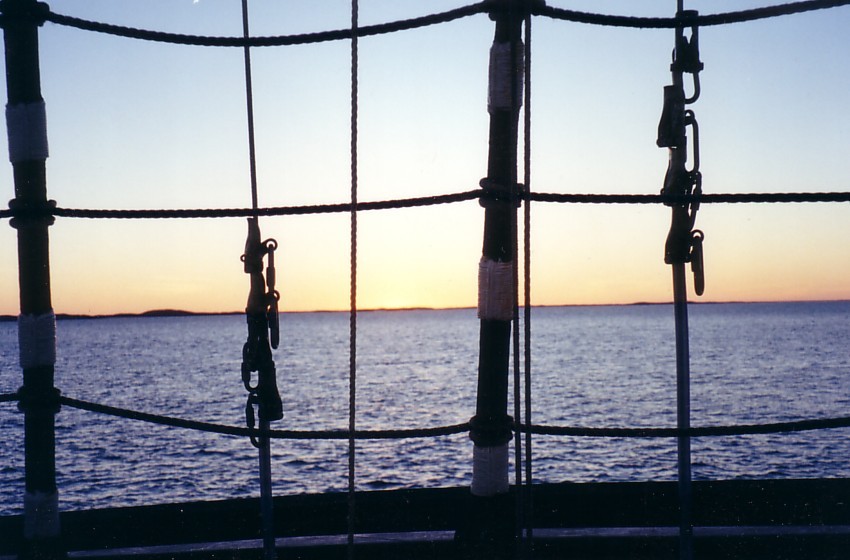
Photo: Barquentine, STS Leeuwin, sailing the Indian Ocean off Western Australia - M Muir

Wednesday, May 10, 2006

Books - FitzRoy

Robert FitzRoy's contribution to science, exploration and humanity was never fully acknowledged in his lifetime. Nor were the half million hand-written words he transcribed about his survey work and voyages. Being the Captain of HMS Beagle which carried amongst its scientific crew the young, Charles Darwin, Fitzroy's work, when published was dwarfed by Darwin's Origin of the Species . It was as recently as 2002 that Fitroy was acknowledged for the invention and instigation of a weatherforcasting system - a system which at the time of its first presentation to British Parliament was received with laugher in the House.
The boy sailor and marine luminescence
Born in 1805, like so many young gentlemen from artistocratic families, FitzRoy joined the Royal Navy at a very early age.
In 1818, at the tender age of only 13, he wrote a letter to his father.
It reads:
Last night when I was coming back, the boat I was in was going very quick, and I put my hand into the water and the little ripple of water it made Sparks, at least they looked exactly like it ... like from a flint and steel, and I could not make out what it was for the oars did the same...
He asks his father to write and tell him what it was he had seen.
FitzRoy and Sea Dust
It was during my first voyage on the tall ship, STS Leeuwin that I first witnessed marine bioluminescence.
I shall always remember the experience, sitting alone on bow watch in the early hours of the morning watching the tiny pin-pricks of light glittering in the sea, appearing and disappearing as if by magic.
I was amazed by the phenomenon and called the particles "illusive diamonds".
It was my "illusive diamonds" which inspired me to write my first novel, Sea Dust.

Reading the biography of FitzRoy by John and Mary Gribbin (2003), I felt an instant empathy for the boy sailor sitting in the small boat 200 years ago. I wanted to tell him I had marvelled at the sea's magic also.
Photo: FitzRoy by John and Mary Gribbin available from Amazon.uk.com

Sunday, May 07, 2006

In Search of Robinson Crusoe

Fact and Fiction interlaced with travel and history
I never read Robinson Crusoe – in fact I never read as a child or for most of my adult life.
Let me qualify that by saying I never read fiction.
I used to spend hours pouring over encyclopaedias and reading non- fiction (or faction as my son calls it – which I think is a far better word).
I can probably list on the fingers of one hand the fiction books I read and reread up to the age of 50: Neville Shute’s A Town like Alice being my favourite.
Yet the irony is I stated writing historical fiction five years ago without having read other historical novels.
One thing University (2001-2004) taught me was to read fiction.
I had to – it was part of the curriculum.
And I started where I should have done 50 years ago with Children’s’ literature.
Now I know what I missed out on.
Now I wish I had more time to read.
As a new reader I try to read across the genres but I find I lean towards historical, and mystery. I like stories based on true events. I lean away from sci-fi, horror and romance.
Having just finished Where the Earth Ends (a journey beyond Patagonia) by John Harrison I must go out and buy a copy of Robinson Crusoe.
I didn’t know the true story of Selkirk, the Captain who was left on an uninhabited island (in the Juan Fernandez Archipelago off the coast of Chile - not in the mouth of the Orinoco), the man who trained goats and cats to dance, the man who the fictitious character of Robinson Crusoe was based on.
John also whetted my appetite for Drake’s voyages around the Horn in the Golden Hinde. I must read those real-life adventures, also Richard Henry Dana’s, Two Years Before the Mast, which tells of his sighting of the (Crusoe) Juan Fernandez Islands in the 1830s.
Fortunately I had recently purchased the biography of Fitzroy, by John and Mary Cribbin (2003). Captain Fitzroy, besides being the inventor of the weather forecast, was the captain of HMS Beagle which took Charles Darwin to the ends of the earth. I also have a copy of Darwin’s The Voyage of HMS Beagle sitting on my bookshelf.
My only problem now is lack of reading time.

Note for John Harrison: I thoughly enjoyed Where the Earth Ends (see posting below). It whetted my appetite to know more about the places, the people and the history of this region. It allowed me to relive the fantastic voyage I took from Valpariso in Chile, via Tierra del Fuego and the Antarctic Peninsular to Buenos Aires in Argentina.
The top of my wish list now is to sail on a square rigger from Ushuaia to the Antarctic.
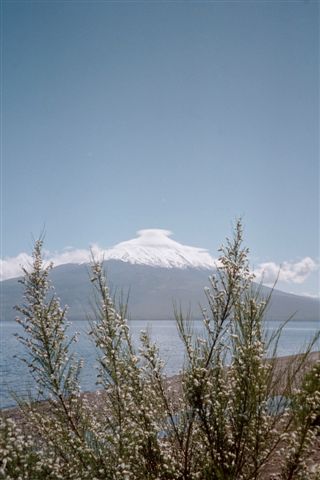
Photo: M. Muir - Osorno Volcano - Chile

Thursday, May 04, 2006

May - Marg's update

Writing:
Galley proofs arrived yesterday for The Twisting Vine.
This is when I check through all the changes that have been marked by the copy editor, proofreader and typesetter before the proofs are sent for printing and binding.
This is not the time for me to be making any further changes to the manuscript, but it is an opportunity to re-read the whole work.
If there are any mistakes which have not already been found, then I can make the necessary amendments.
Changes to the proofs should be kept to a minimum as they can be very expensive at this stage.
Note: Despite the most careful checking, I did find a couple of minor errors in SEA DUST when it came out in print. (I think it happens in most books).
Goats:
Buck and does searated last day in April - that means no kids to be born from beginning of October.
Travel:
Looking forward to holiday in six weeks.
Other:
For now a trip to Perth to see The Fastest Indian - with Antony Hopkins - my favourite actor - next in line - Antonio Banderas.