Friday, April 28, 2006

Guest Author - JOHN HARRISON Finds inspiration Where the Earth Ends


John Harrison's latest book, Where the Earth Ends is about South America and Antarctica.
In 2002, he walked 700 miles through the Andes for his next book, A Walk to the Sun, about the high sierra.
John was the first outsider some of those people had ever met.

‘My father’s family were seafarers, but he entered the airforce when WWII broke out.
After the war, he just wanted a nice safe desk job. Even our holidays were timorous affairs.
But I guess my wanderlust broke out, albeit a little late in life, when I had the chance to visit Kenya in my thirties. I don’t think I’ve had a European holiday since, apart from exploring the British Isles more fully.
There’s nothing like foreign travel to make you realise what you don’t know about your own land.
I always loved maps and geography, encouraged by Dad, who’d been a navigator.
My interest in travel writing also came late, after many years as a fiction writer.
It was travel and memoirs, rather than travel books, which inspired it. I wanted to try to encapsulate something of the whole experience of another place. I think it combines many of my interests. Over and above telling a story, I can play around and weave in fragments of history and myth, a love of landscapes and wildlife, and the layers of culture and literature that give human occupation depth and meaning.
I aim to provide a sense of spirit of place.
‘Where the Earth Ends’ was the result of reading a book called 'Uttermost Part of the Earth' by Lucas Bridges, the son of a missionary who ministered to the Natives of Tierra del Fuego.
Young Bridges was brought up among Indians still living a Stone Age life.
I went there. I had to write about it.
Out of all the things I’ve done, the thrill of getting my first book published matches any of them. When it was made a Sunday Times book of the week, I couldn’t quite believe it! It took a long time to find my métier, but it’s a lovely job.’
About John
Travel writer and environmentalist, JOHN HARRISON, is a native of Liverpool. For twenty years, he worked in planning and environmental matters. His short stories have been broadcast on the BBC and collected in A Short Primer in Vice. His last book, Where the Earth Ends, about South America and Antarctica, was a Sunday Times Book of the Week, and has been translated into German. It’s now out in paperback. Copies are available from Parthian Press parthianbooks@yahoo.co.uk
or if you’d like a personalised signed copy from the author, via his website http://www.cloudroad.co.uk
He is now writing and lecturing full-time, including working as a Field Education Officer for the Royal Society for the Protection of Birds. He has travelled to 42 countries on 6 continents, and has made radio programmes for the BBC on Antarctica and Easter Island.
John's particular interests are the links between real voyages and famous fiction, the remote cultures of southern South America, and the impact of exploration and conquest.
He is a Fellow of the Royal Geographical Society, a member of the Society of Authors, a Fellow of the Welsh Academy, a past Chair of the Welsh Union of Writers, and was for many years a Member of the Royal Town Planning Institute.
Photo: Amazon.uk.com

Wednesday, April 19, 2006

Antarctica - A blue world of ice and sky

Sailing South to the midnight sun
Since posting the blog about the yacht in Antarctica (pictured below) I have emailed various ultimate adventure groups in an effort to find the name of the vessel.
In the process I have discovered that there are several sailing ships - yachts, schooners even square riggers which visit the Antarctic Peninsula during the southern summer months.
Oh, to sail on a tall ship as the explorers of old did!!
I'd love to do it.
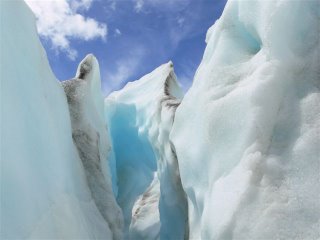
Photo of glacier ice - 'from the inside looking out' - courtesy Robert Dunn

Sunday, April 16, 2006

Deception Island, Antarctica


Safe Harbour in Volcano at the end-of-the-world
The quality of this picture is poor but the courage and audacity of the yacht’s crew for me commands the greatest respect.
I took this photo just over a year ago in Deception Island on the Antarctic Peninsula. (Yes, the word in is correct – I’ll explain later!)
Today I look at the picture and wonder who the brave sailors were who ventured there.
To have rounded the Horn is an awesome adventure; to have sailed across Drake Passage a challenge few would consider; to have contended with the tumultuous seas, icy winds and snow on a small yacht (albeit summer in Antarctica) is near unbelievable.
Having sailed to Antarctica on a cruise ship, I wasn’t able to relate to the experiences of sailing to those lethal latitudes.
The nearest I came was standing on deck for hours armed with a camera – my hands almost dropping off with cold.
But that alone allowed me to conjure in my mind an idea of what the early sailors would have endured on their voyages of discovery.
Deception Island is well named. It is not an island but a huge caldera of a (currently active) volcano. The land which surrounds it (as seen in the photo) sits out of the sea like the rim of a huge teacup. But unlike the white china appearance of the other Antarctic Islands the inside walls of this crater contrast starkly –they are thick with black volcanic ash.
The only entrance to the island is through a narrow crack in the rim but for those who find that entrance, the island's water is welcoming - calm in comparison to the unpredictably moody sea's outside, littered with treacherous icebergs; even warm in parts, where the volcanic activity below heats the water sending clouds of steam rising like smoke on the water.
Despite the inhospitable nature of this end-of-the-world location, in the summer months scientists live and work near the water's edge in the Antarctic Research Stations.
From the ship I saw two, each comprising of a handful of huts which priovide a temporary home in this desolate, virtually inescapable place - one of the most isolated places on earth.
Imagine my surprise, therefore, to see a yacht, moored as if it was in a fashionable harbour in some cold but peaceful bay or river.
In this case, however, the buildings in the background are not a yacht club, but the long abandoned remains from a previous expeditionary/scientific/whaling station.
(Perhaps there is an expert who can put me right here.)
I would love to know who the intrepid crew of the yacht were who had taken their lives in their hands, braved the elements and done what many seamen today and in the past would never contemplate doing.
I envy your courage!
Photo M. Muir – Jan 2005 Deception Island, Antarctica

Tuesday, April 11, 2006

GUEST AUTHOR - Broos Campbell - captured by the sea's magic


Broos Campbell is the author of the Matty Graves sea adventure series. The first book, NO QUARTER, was issued in hardcover by McBooks Press of Ithaca, New York, in April 2006
When I was 40, I ran away to sea.
I’d grown up reading the Hornblower books and I wanted to see for myself what square-rig sailing was like.
And I didn’t like it.
I hate being cold and wet, which sailors are most of the time. And I hate making a fool of myself, which there’s plenty of opportunity for in a tall ship.
But it was only a two-week stint, anyway, in the brig Lady Washington out of Grays Harbor in Washington state.
We’d motor out of the harbor and then the captain would cut the engine.
There would be a terrible lull, with the waves lapping at the hull and the masts swaying in the swell.
Then the captain would call, “All idle hands, lay aloft!”
There’s no “after you, mate” in a square-rigger.
If you’re next to the windward shrouds when the call comes, up you go.
It’s that or go ashore. No one trusts you, otherwise.
We were coming into harbor one evening after I’d been aboard about a week.
We’d furled everything and had nothing more to do till we reached the dock but loaf around.
I was sitting on the fore topmast yard talking to an old hand.
She looked around at the forest stretching off into the distance and the setting sun lighting up the clouds with God rays, and said, “Don’t you just love it?”
I said no, I hated it.
She said she’d hated it too for the first week, but then suddenly it had become magical.
I didn’t believe her.
I was too ashamed of my misery to find my way out of it.
But the next evening there I was again, in the same place, dangling my feet and looking around at the view - and it was magical.
I suddenly realized I was exactly where I belonged and I had no desire to be anywhere else in the world.
It’s hard to come by that sort of serenity.
You won’t find it in a bottle, and you won’t find it in someone’s arms.
You can only find it by being absolutely worthy of the trust that others place in you.
That’s the only place I’ve ever found it, anyway.

To find out more about the Matty Graves series, try e-mailing Broos. He can be reached through his admittedly rudimentary Web site at http://www.broos-campbell.com/
Broos' photo by Walter Mladina

Marg's update - Bitten by the bug

At long last the muse has returned and I am back to solid writing!
Not sure of the title of the next book (possibly The Black Thread) but it's set in Yorkshire (where else?) in the late 1800s.
By Chapter 4 the protagonist is on the run.
Can the Leeds/Liverpool canal offer a means of escape?

After reading of my interests, Andrew Denny, master of, Granny Buttons, a narrow boat, asked if there would be a goat in the next book. He told me he once saw a goat on a barge on one of the English canals. I wish I'd seen that.
Maybe I can sneak one in somewhere....
PS - Thanks to Andrew for the information I have gleaned from his site and the canal links it has taken me to.
Definitely worth a visit: http://www.grannybuttons.com/granny_buttons/

Wednesday, April 05, 2006

The Narrow Boat - sliding into the past


The days of the old working narrow boats are gone and today most canal barges are used as pleasure craft.
The history of the canals however is intruiging.
I'm currently reading the book, Narrow Boat, by LTC Rolt which was first published in 1944.
It's a beautifully written testament to the old boats and reading it transported me back to the days when the canals were still thriving, though at the time of writing, the signs of them being neglected and falling into disuse were definitely showing.
I remember crossing the Leeds/Liverpool everytime I went into to Leeds when I was a girl.
The canal looked black and dismal and its littered banks were an area to be avoided.
It is wonderful that many of the canals throughout Britain have been cleaned up and are in use again, albeit for holidaymakers.
Back to Mr Rolt's book:
Reading about the narrow boats with their polished brasswork and painted decorations of flowers and castles, about the boatmen and women and their traditional dress, about the pretty lock cottages and Inns and the operation of the staircase locks, I find everthing connected with the narrow boat inspiring.
So much so, my next story incorporates the Leeds and Liverpool canal of the 1890s in its pages.
At the moment I haven't got a working title but am considering - 'The Black Thread'.
When I visit Leeds this year, I will make a point of re-visiting the canal and learning first hand how the lock paddles operate - and I must get some photos.

Photo curtesy Andy Roberts Inland Waterways - http://waterwaysphotos.blogspot.com

Books - 'Sea Dust' - SOLD OUT ALREADY


Great news this week - just heard that my novel, 'Sea Dust' has sold out of its first print run.
Hale Books, the publisher has only 2 hardback copies left in stock.
With my second novel - 'The Twisting Vine' - due in August, I am hoping it will be as well received.

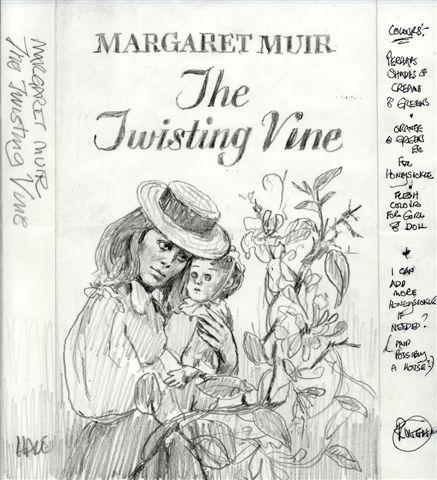
This is the artist's cover rough for 'The Twisting Vine'.
I feel that the girl has a hard face and have asked that it can be softened.
It is not a baby she is holding, but a French Bru Doll.
The doll has an unobtrusive presence throughout the story and I had written this novel under the title, 'Through Glass Eyes', however the publisher did not like it, hence the change.
Cover rough for The Twisting Vine by unnamed artist - courtesy of Robert Hale Books, London

Monday, March 27, 2006

Guest Author - Maggie Lilleby on writing, travelling and cycling


Maggie is a children’s writer. She lives in Nelson New Zealand.
It’s often said that as kids, writers were always scribbling.
I certainly was. I didn’t keep any of the old stories, poems, songs, and plays I wrote – I wish I had, they’d have been funny and probably embarrassingly awful to read now.
I was always a great reader, too, my favourites being the Greek, Roman, and Norse mythologies, and the stories of King Arthur, Merlin, and the Knights of the Round Table. Mary Stewart’s Merlin quartet (The Crystal Cave, etc) still rank among my favourite books.
Although I’ve written adult short fiction and many non-fiction articles on travel, health and fitness, and cycling, I’ve focussed mainly on writing for children.
My first children’s book was published in 2002, a sporting novel about cycle racing.
I found it relatively easy to write as I’d long been a fanatical cyclist and had raced myself on road, track, and mountain bike. I represented New Zealand at the Oceania Games in 1986 – not a particularly successful exercise as I crashed after a few kilometres.
I enjoyed writing the book as I put a lot of my own knowledge, enthusiasm for the sport, and experiences into it. Currently I’m working on ideas for another children’s novel.
Much as I enjoyed cycle-racing, cycle-touring was always my first passion, especially in France. I have visited five times. France is an amazingly beautiful country, perfect for cycling – some fabulous countryside, and I love the medieval villages, castles, and churches, and of course the food and wine! And everyone is either a cyclist or a cycling fan.
Unfortunately, I don’t do as much cycling now, but I still love the sport. And I’m never happier than when I am whizzing around on my bike!
One of the highlights of my year is watching the Tour de France on video. I actually followed a couple of stages of the Tour in the Pyrenees several years ago – totally blew me away. As far as I’m concerned, those guys are super-heroes!
I also write a lot of children’s non-fiction, mostly for the New Zealand School Journal and other educational publishers, including the US/Canada market. I’ve learned an awful lot about such diverse topics as orienteering, sea-kayaking, belly-dancing, kite-boarding, mountaineering, tsunamis, the Bermuda Triangle, and extinct and endangered species.
Writing for and about kids is fun – you get to share in their enthusiasm, imagination, creativity, and energy.
Maybe I’m just a big kid at heart!
photo: Robert Dunn - 'The Remarkables', nr Queenstown, NZ (2005)

Saturday, March 18, 2006

Back on Track


Goat track: Autumn in Western Australia and time to introduce the bucks to the does. Necessary but noisy!

Writing track: Not on track – the writing will not flow – too many distractions and the mind doen't want to work in a disciplined manner.

Holiday track: YES!!
Been busy organising a holiday to UK and Europe, travelling initially with my son.
The mind is working overtime here!
I recently discovered my brother, who lives in the south of England, not only has part share in a yacht but also an aircraft.
He has offered to take us sailing for a couple of days out of Portsmouth.
Because I love tall ships, I am looking forward to seeing Nelson’s “Victory”, and the “Mary Rose” if possible.
If we take a flight it will be over the Isle of White and Portsmouth Harbour – UNREAL!

Because I love also ocean cruising , I have been tempted by a cruise in the Mediterranean.
Ten days sailing out of Rome to Naples, Greek Islands, Sicily and South of France and Florence.
I’m just in the process of working out the best way to get there.

When I am in the UK, I hope to visit Hale Books who published SEA DUST and to meet the agent who secured that contract and the contract for my second novel, THE TWISTING VINE. I could not have managed to get where I am without him.
You can read a progress report on where the publishing process for the book is at at the moment at: http://squidoo.com/thetwistingvine

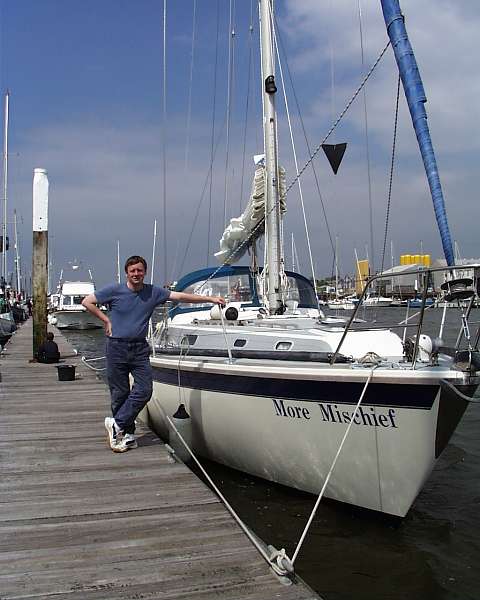
Photos: Bro with boat (cutesy Nigel Leak)

Big Boy's Toys


My son's eye's lit up when he heard about the chance of a flight.
"I've jumped out of a few of those," he said.
I just hope I don't have to jump out!

Photo curtesy N. Leak

Monday, February 27, 2006

Book launch - The Sweetest Taste


An Aussie author said that the champagne to celebrate the launch of one's first novel was by far the sweetest.
I'm sure she was right!
With forty friends and my son, Rob, alongside me, we gave Sea Dust a great send off.
I had a wonderful time.
(The Large Print rights to Sea Dust have been sold to Thorpe Publishing, London. It will be published in 2006)

Sunday, February 26, 2006

SEA DUST launched


It's a bit belated but today it's happening.
I am celebrating the launch of my first novel, Sea Dust, published by Robert Hale Ltd, London.
Sea Dust was released in the UK in December 2005 and Australia this month (Feb 2006).
This afternoon, my son, Rob, will official launch the book at a small party held at home.
I will not be breaking a bottle of champagne over it, but I will make sure we hear a few corks popping!
Though I say it myself, "Here's to Sea Dust!"

Thursday, February 09, 2006

Nursery rhymes – the cornerstone of learning

Baa, Baa - not such a black sheep!
Nusery rhymes have been around for a long time.
Possibly the oldest line from a nursery rhyme is ‘Eena, meena, miny, mo’, reputed to have been recited by the Druids thousands of years ago when they picked their victims for human sacrifice.
But whatever their purpose or attraction, nursery rhymes have survived the centuries and are one of the infant’s earliest encounters with the English language.
Walter de la Mare described nursery rhymes as:
‘tiny masterpieces of word craftsmanship – of the latest device in rhythm . . . not only crammed with vivid little scenes and objects and living creatures, but, however fantastic and nonsensical they may be, they are a direct shortcut into poetry itself.’
Nursery hymes teach rhyme and rhythm, and through repetition, they teach the alphabet.
They introduce the child to words, sentences and syntax with rich examples of figures of speech such as tongue twisters (How much wood could a woodchuck chuck) and alliteration, (Sing a Song of Sixpence).
And with an appreciation for words and verse, the child learns to read.
This, in turn, later provides the author with a market for both children’s and adults’ books.
Modern English of the twentieth and twenty-first centuries has been modified in line with changes in culture and society.
Since the Middle Ages there have been wars, plagues, and the Industrial Revolution.
Today, space exploration and DNA cloning are things of the past.
Yet despite this, the poetry of the nursery rhyme has survived and almost all of today’s great leaders, writers and philosophers (though they may not like to admit it) have cut their teeth on ‘Baa Baa Black Sheep’ and ‘Humpty Dumpty sat on a wall’.
Photo of one of my melanian sheep with lamb - M. Muir

Tuesday, February 07, 2006

Writing for Children

The day the scarecrows came to town
I got the idea for this children's story after visiting a Small Farms' Field Day held in a country town in Western Australia.
One of the main events was a scarecrow competition.
I was amazed, I had never seen so many scarecrows!
They were big, small, fat, thin, and dressed in all manner of costumes - guaranteed to send the imagination haywire!
My story, about Sam a rather delapidated straw man, had quite a cast of scarecrows in it.
And I even wrote a sequel.
Unfortunately, my limited attempts to get the story published were unsuccessful.
Perhaps now, with a little more knowledge of the publishing business, I should try again.

Photo: Me and a scarecrow at Balingup several years ago. The scarecrow is the one with the long nose!

Thursday, February 02, 2006

Writing for Children - goats always popular


The Three Billy Goats Gruff
"Whose that tripping over my Bridge?" roared the Troll
Children love goats and they also love stories.
But to write a good children's story is an art. Getting published, even harder.
Because a children's story is short, it looks easy - but I assure you, it's not!
I've written a few children's stories - but never sold any.
The problem is, the of type story I write, is the type I listened to when I was a girl.
Now that was some time ago!
Today's kids live in a different world to the one I grew up in - they face different challenges - learn different things.
Consequently, the stories they read must appear within the sphere of their world.
Writers who have discovered that special link to the childhood imagination are lucky. With the right formula they are in demand from both readers and publishers.
In the meantime, I think I'll stick with the adult stories and the goats!

Photo: M Muir - Three of my angora bucks at Bluegum Park in Western Australia - visit my goat site at http://www.squidoo.com/goatlady

Friday, January 27, 2006

...on the sheep's back - guest author - John Barlow


INTOXICATED, the new novel by John Barlow, is set in rural Yorkshire in the late 1860s.
It follows the exploits of wool combing magnate and self-made-man Isaac Brookes, at a time when:
...men rose from the muck and clatter of their mills like patrician-gods of the new alchemy, who took raw wool, still filthy and stinking with the grease of the animal, caked with shit, rank and sour to smell. From this they conjured piles of gold in such quantities that talk of their wealth sounded like a hoax... men, in short, who were no longer of the common world, not even men of the world, but stood like giants above the rest, looking down with benign satisfaction on what they had created...
But this is no ordinary commercial novel. In addition to the wool, it features Rodrigo Vermilion, a foul-smelling humpbacked midget with a gift for words.
He persuades the Brookes family that the future lies not in wool combing, but in sweet, fizzy drinks.
‘Rhubarilla’ is born, a rhubarb based soft drink that takes the world by storm.
INTOXICATED: A NOVEL OF MONEY, MADNESS, AND THE INVENTION OF THE WORLD’S FAVORITE SOFT DRINK is a fantastical tale of sheep, booze, rhubarb and cocaine... a wild, big-hearted spoof of the invention of the soft drink industry.
Published by William Morrow on February 7th, 2006
To find out more about John and INTOXICATED - go to http://www.johnbarlow.net/

Wednesday, January 25, 2006

History and fiction intertwine


Mystery surrounds origins of Bagot goat

“The little known history of the Bagot goat is interlaced with images of knights on horseback, kings and coats of arms. A story spanning 800 years where fact, legend and folklore are closely intertwined.
When Richard the Lionheart returned from the Holy Land in 1194, Prince John was Regent of England and Robin Hood championed the poor from Sherwood Forest – the legend is well known. But what is unknown is that when Richard returned from the crusades it is thought he brought back a few black-headed goats from the Rhone valley of Switzerland.
Two hundred years later in 1380, a young Richard 11 presented a herd of black and white goats to Sir John Bagot of Blithfield Hall in Staffordshire.
These were released into Bagot Park, 800 acres of woodland on the edge of the great Needlewood Forest. This was their home for 600 years.
But in 1939, Blithfield Estate was bought with the intention of drowning the land to create a massive reservoir.
The following year the War Agriculture Executive issued an extermination order which Lord Bagot disputed. The goats received a reprieve but in 1953 most of the land was flooded and the remaining land cleared for farming.
Of the hundreds of goats which had freely roamed the woodlands only 20 were kept. These were brought to the Hall by Lady Bagot.
The goats now had to live in a walled garden and small paddock close to the house. Gone was the forest habitat and with it the goats’ future.
By 1979 only 12 goats survived giving them the dubious distinction of being the rarest of the rare breeds of the British Rare Breeds survival Trust.
Nancy, Lady Bagot had no option but to entrust their survival to the RBST.”

I wrote this story for The Goat Farmer Magazine (NZ) June 2000, I now discover that the legend in which Richard the Lionheart plays a central role, has been questioned and partially disproved.
It appears that the goats did arrive at Bagot Park in the late 1300s as a gift from Richard 11. But the question remains, where did the goats come from?
One supposition is that in 1386 when John of Gaunt set sail, he was joined in his crusade by the King of Portugal. But it was not long before the English army started to waste and Sir John Bagot, returned to England.
Recently, DNA teats conducted on the goats showlinks, however slight, with a Portuguese and a Pyrenean goat.
It also shows that there are no links to the Swiss Schwartzhal goat.
However, it will take further investigation to prove this and until then, this ancient breed remains veiled in the mists of time.
And I am sure, however, that no-one will dispute the fact that the Bagot goat is a noble beast with a long and noble heritage.
My thanks to Peter Evans for the photograph and to the Bagot Goat Breed Society's website for this updated historical information.

Sunday, January 22, 2006

The Sea’s Magic


You will never see the sea’s magic from the deck of a cruise ship. There are too many lights and it’s impossible to get close enough to the water.
The first time I saw the sea's luminescence was when I sailed for 12 days on an 1860s-style barquentine on the Indian Ocean.
One night, when there was no moon, I was on the bow gazing at the black ocean, when suddenly my eyes were alerted to the tiny glimmers of light which appeared and disappeared in the foam.
The tiny pinpricks of light reminded me of the millions of stars which seed the sky on a clear West Australian night.
It was like magic.
But it seems that for centuries men have puzzled over the cause of this phenomenon.
Long ago, men thought they were the sun's rays which had dived into the sea.
They said that at night the fiery spirits tried to escape the water and fly back to the heavens.
Some said the troubled sea created sparks like those emitted when a flint is struck upon a stone. Some said they were small fish or insects which were able to glow like the firefly.
Some said that sometimes the particles came alive and swirled together in a shining mist of colour which floated across the sea turning like a spinning top.
Some said this was an aurora.
Some said it was an illusion.

In my novel, Emma asks Charles:
“And what do you say?"
"I say it is a wonder. Each flash of light is from an animalcule, a minute organism. It only glows when turbulence disturbs it. The ship is causing it to shine."
He looked at her, but her eyes were fixed on the metallic sea. "Your tiny stars are no illusion, Emma. They are real. Millions upon millions of them. And perhaps as you suggest they lie in wait for ships to pass so they can come to life and dance together in the foam."

Read more about the sea’s magic in, ‘Sea Dust’. You can order a copy on my website at http://www.margaretmuirauthor.com

Wednesday, January 18, 2006

Sailing at its best!


After three weeks at sea, our voyage across the Atlantic is almost at an end. As the clipper nears the Leeward Islands, the first storm hits at 11 pm. It arrives stealthily out of the night and takes everyone by surprise.
The ship heels and for fifteen minutes the wind speed reaches force 9 on the Beaufort scale. The sound of the gale ripping through the rigging is thunderous. What we experience is a tropical low. Fortunately it does not intensify into a hurricane.
The following day with the West Indies almost in sight, another storm looms on the radar. On deck all eyes are fixed on the gathering clouds. At first they flank the ship. Rolling. Moving rapidly. Spawning smaller storms which quickly close in. The automatic pilot is switched off. The helm is manned. Sails are furled and the cat and mouse game of storm evasion begins.
From the deck I see the rain approaching. As it gets closer, the surface of the sea bubbles. The storm hits. It lasts for twenty minutes.
Standing on the leeward side, the sea and sky meld enveloping the ship in an eerie aura of strange aqua light. The rain blows horizontally. The sea boils and the gunnels lean down to meet it. In the dining room, plates and glasses crash to the floor. Passengers grapple to remain upright – but throughout the storm they thrill to the excitement. This is sailing at its best!

This excerpt is taken from an article I wrote which was published in the Weekend Australian 11/2005. You can read the full story of that journey on my website at http://www.margaretmuirauthor.com It is titled: "In the Adventurers' Wake".

Tuesday, January 17, 2006

The Call of the Sea - guest author - Joseph O'Steen


Joseph O’Steen creator of the Nathan Beauchamp series is intrigued with the history of piracy:

“I first went to sea at the age of four. As the son of a commercial fisherman I spent my early youth with him on the shrimping grounds off Florida.
Usually we only went out in good weather but one trip caught the boat on the edge of a hurricane. The adults were frightened but for a seven year old, tied in the wheelhouse chair, riding the 30-foot waves it was like a carnival ride. They were the happiest times of my childhood.
But when I reached the age of eleven, everything changed.
In 1961 I sailed into St Augustine, Florida with my father who was captain of the shrimp trawler Rodonsetta.
My mother had escaped him some years before, so now my care was placed with one of his female friends.
One night while he was away, I woke up alone.
I never saw his girl friend again and I only saw him one other time after the O’Steen family took me in and I settled into a life ashore.
I heard about my Dad a few years later. He had sailed to the west coast of Florida, gone on a drinking binge and sold the boat he was captain of at the time.
And the Feds were looking for him for piracy - it seems the vessel was not his.
So I guess that makes me the son of a pirate!
But that was the best thing for me, as I stayed with the O’Steen’s until I joined the navy. That was when I took their name.
I have not told this story to many, but I think of it more as I grow older.
And now I think, perhaps that may be why I am drawn to the history of piracy.”

To read more about Joe, his books and his love of everything nautical visit his website at http://josephlosteen.com/

Saturday, January 14, 2006

The Call of the Sea


There is something mysterious about the sea.
Its physical effect can be destructive.
It’s visual image, calming.
Over the ages young men have been drawn to it, never questioning its dangers, never wanting to leave. And the sea has held them in its grip till they have given up their souls to its depths.
But what is it about the sea that draws them? Is it the mystery, the awe, the emptiness?
Is it the chance to witness the power of nature – untamed and unchanged over the millennia?
Consider this seaman’s view:
‘How beautiful she is,’ he said, gazing at the water. ‘La mer. So like a woman.’ His body tensed. ‘Look.’ he said, ‘how soft and flat she lies in the night. Smooth, like silk. Black. Beguiling.’ His tongue touched his lips. ‘I can taste her salt. And listen,’ he said, his voice barely a whisper. ‘Listen. Hear her breathe. Softly. Slowly.’ He paused. ‘She sleeps.’
In these lines from my historical novel, Sea Dust, I have tried to convey that intangible effect the sea has on some men.
It was not an easy task, but if I have captured something of the essence of the ocean, I am pleased.
Two independent pre-release comments say:
“This story inspires the reader to begin their own sea-faring adventure.” (Nicole Biber, Melbourne, AU)
“…for one who has never sailed, I found myself wondering what it would be like to be at sea."
(Marie Hohrmann, Perth, AU)
If you would like to read more about Sea Dust please visit my website at http://www.margaretmuirauthor.com

Sea Dust


Sea Dust published by Robert Hale Ltd, London, December 2005.
Due for release in Australia Feb 2006

Monday, January 09, 2006

Destination Paradise

January - country Western Australia - and it's hot!
Another blistering 100 degree day – and more to come.
I sit at the computer, wipe the perspiration from my brow and dream of Paradise.
‘Paradise’ - what does that word conjure in your imagination?
Some ethereal super film-set with billowing clouds floating like fluffy magic carpets transporting harp-playing angels to who knows where?
The ultimate destination on many people’s life wish-list! Maybe.
Talking of ultimate destinations – then consider Paradise Bay.
If you were asked to write down what images come to mind, how would you describe it?
Blue sky reflecting from an even bluer lagoon. A tropical island perhaps? Crystal clear water rimmed with white sand, shaded by a fringe of palm trees which lean down to touch the lazy water?
Maybe.
Then imagine this - Cold. Colder than you have ever known.
Instead of clouds floating like fluffy magic carpets, imagine icebergs motionless on a mercury sea.
Instead of palm trees leaning down to touch the water, a rainbow arching slowly from the land to barely skim the water's surface before sliding back into the bay.
Instead of white beaches, imagine being surrounded by walls of ice – some smooth and undulating, some fractured, all frozen - white, blue and dappled grey.
And as the snow begins to fall imagine a ship’s deck and fittings upholstered in a carpet of soft white shag-pile.

Back in the real world – I add more ice to my drink, gaze at the holiday photos and let my mind transport me back to a cooler kind of Paradise:


Paradise Bay, Antarctica (Jan 2005) photo Peter J Ryan

Thursday, January 05, 2006

Illusive/elusive – love, life and book titles

A book's title, while it’s a work in progress, is like a pair of old slippers – comfortable, warm, fits like a glove.
So what happens when the publisher says he doesn’t like it?
The old slippers have to go and you have to break-in a new pair.
Of course, at first, they don’t really fit and your feet don’t slide in easily.
But, before long you find yourself wearing them and not noticing the difference.

But are they ever the same?

I wrote my first novel with the working title, Illusive Diamonds, and qualified the title with a short haiku verse:

luminescent particles
stirred by the ship
dark sea’s illusive diamonds

This brief description relates to the marine organisms which appear and disappear in the sea at night - as if by magic.
It also alludes to the illusive (and elusive) nature of love – at times appearing suddenly, as if out of the blue. But then vanishing equally as quickly.
When a critic advised me that the title, Illusive Diamonds, should go, I took his advice and changed it to Sea Dust.
The words ‘sea dust’ carry similar connotations regarding the marine particles. But ‘sea dust’ also carries the connotation of ‘ashes to ashes, dust to dust’ and of those whose bodies are committed to the sea.
As my novel has a strong nautical component – the title seemed fitting.

Last week, Sea Dust was launched in England.
Last week, in a sad twist of fate, I scattered my partner’s ashes on the sea.
Peter Ryan was with me throughout the writing of my novel.
Apart from being my dearest friend, he was also my most valued critic and editor in the novel's early stages.
He died in a horrific accident six weeks before the launch and never saw Sea Dust published.
For me, as for Emma (the character in my novel), I feel love is illusory.
But unlike the marine luminescent particles which glitter and die in the dark sea, the wonderful life and love, which Peter and I shared, will shine forever in my memory.

Watching the sun rise

Peter and I - mid Atlantic - on the sailing ship, Star Clipper - November 2004
(photo by Lo Smith, USA)

Tuesday, January 03, 2006


Under a clear blue west Aus sky Posted by Picasa

It's easy!

"Always think of what you have to do as easy and it will become so." (Emile Cove)
Up to now I had a mental block about setting up a blog.
After reading the above quote, I thought, what the heck, it's got to be easy!
So here I am.
The birth of my blog coincides with the publication of my historical novel, Sea Dust, which was released in the UK on 31 December 2005.
You can read more about Sea Dust on my website.
You will also learn something of my love of tall ships and the sea and about some of the voyages I have taken.
Something you won't read about is my love of goats - yes, goats! I have been breeding them for 17 years and have written numerous magazine articles about them.
Today, I only have a small herd of about 40 South African Boer goats, but in the past have bred angora goats (which produce mohair fibre and not angora which comes from a rabbit) and some of the dairy breeds.
Perhaps one day I will put all my thoughts and experiences on paper. I know there are people out there who will be interested in reading them.