Thursday, July 27, 2006

HMS Mary Rose

There has long been a rumour that Henry V111’s ship, the Mary Rose sank on her maiden voyage.
This is not true.
Launched in Portsmouth in 1511, from 1512 to 1514 she faught the French in the English Channel off Brest and Cherbourg.
In 1513 she was engaged against the Scots off Newcastle
During the second French Wars, 1522 to 1525, she was again fighting at sea, and it was when she was about to sail against the French, in 1545, that she sank not more than two kilometres from Portsmouth harbour.
There she sat for well over 400 years, her keel and starboard side encased in a protective layer of Solent silt.
The Mary Rose was lifted to the surface in 1982 from which time restoration work has been ongoing.

To visit to the Royal Naval Dockyards at Portsmouth to take in the sheer magic and majesty of the three vessels housed there (The Victory, The Warrior and the Mary Rose), to ingest all the information available, is wishful thinking.
I left my viewing of the Mary Rose to last, I suppose because the shed she is housed in is not as inviting as a two tall ship sitting in a dock in front of you.
Now I wish I had had given myself more time.

Consider the Mary Rose, a purpose built warship, built almost entirely of oak.
Consider life on board in the early 1500s – as revealed by the thouseands of artefacts brought up with the ship.
Consider the men who sailed her – the mariners who earned 6s 8d a month (1545).
Consider the perilous tides and currents of the Solent which can toy with today’s vessels, vessels equipped with the latest in navigational equipment. For any ship to sail in and out of these waters was a feat all of its own.
When the Mary Rose went down, for as yet unknown causes (though several have been postulated), she took most of her crew of 385 (at least) with her.
The remains of 200 of these men were uncovered within the wreck, the majority being healthy young men in their late teens or early twenties.
Note on photo: Though I tried to photograph the ship though the Perspex walls and treatments mists of its sealed environment, my attempts were unsuccessful for reproduction here. I have therefore taken the liberty of photographing the ship from the Mary Rose, Museum and Ship Hall book, which I purchased during my visit.

HMS Warrior - Britain's finest warship


It’s quite possible that when HMS Warrior was launched at Blackwell in 1860, the event may have been witnessed by an old seadog who had served under Nelson on the Victory.
Imagine his amazement at the changes which had taken place in ship design and construction in only 50 years.
From wooden hulled fighting ships like HMS Victory to an iron framed, armour plated warship equipped with both sail and steam and driven by a propeller. The Warrior could sail before the wind under her 48,400 sq foot of sail or head into the wind, its 10 boilers and four furnaces operating at searing temperatures to power its huge engine.
Its two massive funnels were telescopic and could be cranked down when steam was not required.
Its four 5.6 ton anchors at both bow and stern, each needed 100 men on a capstan to raise them.
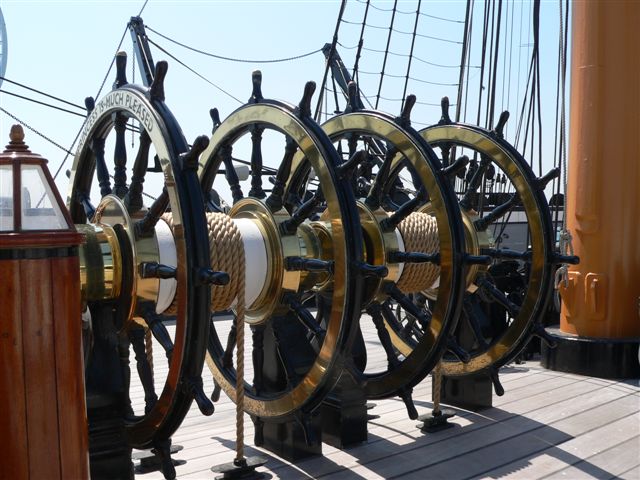
It’s 4 wheeled helm (as in the picture) which at times needed 16 men to hold the ship on course.
A speed of 13 knots under sail and 14.5 in steam.
A crew of 700 men now dressed in the uniform of the Royal Navy.
But perhaps most of all to its fighting power:
Twenty six 68 pounder muzzle loading guns
And ten breech loading 110 pounders.

Stepping on the Warrior’s deck, and wandering through the massive ship, is like taking a step back in time.
Having the opportunity to do that is thanks to the Warrior Preservations Trust and the men who rescued her from the scrap yard on more than one occasion in her life.

Sadly, HMS Warrior’s days of glory were few.
By 1870 masts and yards had become obsolescent.
She had served as Britain’s finest warship for only 10 years.
For the next 100 years she found service only at the bottom end of the maritime ladder.
But in 1979, with her hull still intact, she was taken to Hartlepool for restoration. Eight years later, surrounded by a flotilla of small ships, the newly restored warship was towed to the Royal Naval dockyards at Portsmouth, where she stands today – a tribute to the shipbuilders of the mid 1800s.
Photo: M. Muir – The Warrior’s mighty helm

The SS Great Britain - Magnificent cruise ship


On my recent cruise of the Mediterranean, I had a wonderful time and visited some wonderful places. The ship I travelled on was approximately 70,000 tonnes and was American owned.
The service was excellent.
The cuisine was excellent.
The staterooms (cabins) were excellent.
The only thing I could fault the ship on was its internal decour.
It was dull and at times rather jaded-looking.

Consider the dining room in the above photo.
This was taken inside the SS Great Britain - a cruising ship built in 1843.
I accept that she has been refurbished but the layout, with its marble pillars and sumptuous furnishing, reflect on the luxury of sailing first class in the mid nineteenth century.

More on the SS Great Britain on a later blog.
Photo: M.Muir - SS Great Britain - Bristol

Tuesday, July 25, 2006

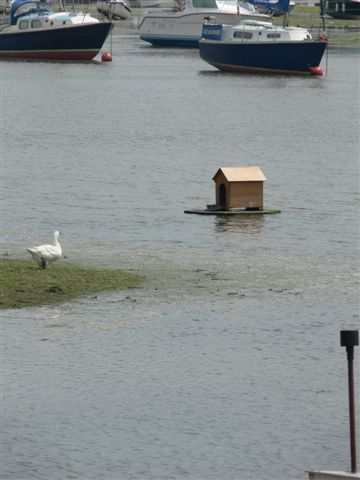
Sea dogs????


I've heard of old sea dogs!
But the sight of a dog kennel floating on a river in the Isle of Wight left me scratching my head!

Photo: M. Muir July 2006

Monday, July 24, 2006

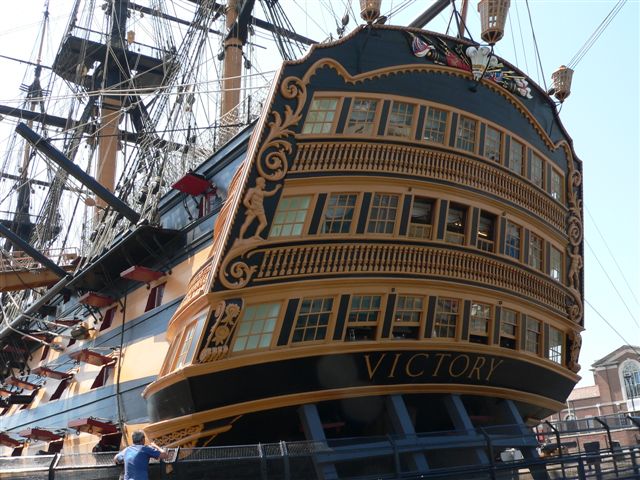
Nelson’s ship ‘Victory’

A couple of weeks ago I stood on the deck of HMS Victory and gazed down at the plaque which marked the spot where Nelson fell.
So immense was the impact of the great ship, I had to wipe the tears from my eyes.
I can honestly say I have never been so awed by a tall ship in my life.
The sheer size of Victory is amazing. The length of its decks, the number and size of its guns.
And below decks the area where the everyday life of the ship was conducted: the quarters, the cabins, the sickbay, the huge staterooms – one Admiral Lord Nelson, another other for the Captain Hardy; the furnishings, including the original round table used by Nelson in his day cabin; and a replica of his hanging cot with its delicately hand-embroidered drapes.
Launched from the Chatham dockyard in Kent on 7th May 1765, it is said that Victory was then more ornate than she is today.
That is hard to believe!
She carried a crew of 850 and a complement of 104 guns including two 68 pounder carronades, and remained in service until 1812.
At 3500 tons, this formidable fighting machine could sail at a speed of 11 knots under a spread of 37 sails.
What a sight she would have been!
Victory was brought to her present berth at Portsmouth’s Royal Naval Dockyard in1922 where she stands proudly as the centre piece of a remarkable collection of true nautical heritage.
To one side she is flanked by the HMS Warrior – Britain’s first and last iron hulled warships (1860) – on the other, the remains of King Henry V111’s ship, the Mary Rose (1510).
I will write more on these in a later entry.
If I had seen nothing else on my visit to England, I would have been satisfied in having visited this magnificent ship.
Over 33 million visitors have trodden Victory’s decks before me and I am sure most will have left with feelings similar to my own.
If you love tall ships or history, a visit to the naval dockyards at Portsmouth is a must.

More info at http://www.hms-victory.com/
Photo by M Muir

Saturday, July 22, 2006

Visit to Hale Books, London


Situated in Clerkenwell, Robert Hale Limited is close to Fleet Street and is situated not far from the area of London which was once the hub of the British publishing industry. Today, I learn, much of the work is decentralized.
This is the case with Hale Books.
As one of their 'overseas' writers, I could not resist a visit to the publishing house which has accepted me into its stable of authors.
Hidden behind a row of tall trees, Clerkenwell House, a building which once accommodated much of the book production and distribution for the company, is now mainly sublet as offices. The bulk of the actual book production/printing is done outside The City.
Today, Hale's offices take up the fifth floor of the building offering striking views across the rooftops to the dome of St. Paul's Cathedral.
Meeting Mr Hale was a highlight of my visit to England. The fact he said that he wanted some more work from me inspired me to get back home to continue writing.
At Hale, I also met members of the editing and production staff who until now had only been names on the bottom of emails. It's so much nicer to be able to put face to a name.
Before I left, Mr Hale gave me a copy of the cover of my next novel, The Twisting Vine.
This, my second novel, is a fast-moving Yorkshire saga.
It is set in the period 1895 to 1920, where peace and war, joy and grief, are linked by the unobtrusive presence of a French Bru doll.
The Twisting Vine is due for release in hardback in England on 30 August.
Cover art - The Twisting Vine by Margaret Muir - Jacket illustration by Barbara Walton

Pompeii, Pontefract and back to Perth

What a whirlwind!
It's amazing what one can pack into five weeks.
I've seen unforgettable sights, been to amazing places, met wonderful people and gleaned some great background material for future books.
It's impossible to rate one visit over another but The Vatican City and its art treasures, Pompeii, and Nelson's ship, Victory, seem to vie for the most attention in my memory.
Over the next few weeks, I'll be blogging about some of the other ships I've seen including the SS Great Britain and King Henry V111's, Mary Rose.
I'll introduce two of the writers who I met while in the UK, historical novelist, Fenella Jane Miller, and biographer, Hester Davenport.
For those interested in holidays afloat, I'll take you back over the cruise I took which included stopovers in the major tourist ports in Italy, Greece, and the South of France.
Though my home is Australia, my roots are in England, so naturally I enjoyed visiting family and revisiting old haunts.
Whitby, where my previous novel, Sea Dust, was set, was high on the list.
So was Saltaire, the town where my work-in-progress is located. The locks and canals of the British waterways were of interest as they also play an significant role in the story.
Ilkley and the Yorkshire Moors were on my list as they feature in, The Twisting Vine, my next novel, due out next month.
That was the only day it rained during my holiday. The Yorkshire Moors looked bleak as usual.
I sailed to Cowes in the Isle of Wight, flew over Watership Down, and ambled around Flatford Mill near Dedham where John Constable captured the beauty of the English countryside.
Finally, a visit to meet my publisher, Robert Hale Ltd in London was a highlight.
It was an unforgettable holiday - but I am glad to be home.
Photo: The Thames, London, July 2006 - Robert Dunn

Wednesday, June 14, 2006

Ashes to Ashes, Dust to Dust

PJ and I met on a ship on the Indian Ocean.
We shared a love of the sea, of writing and of travelling.
In the two and a half years we were together we sailed on the Mediterranean, cruised the Indian Ocean and the South China Sea. We crossed the Atlantic on a clipper and flew across the Pacific three times. We even voyages through the Southern Ocean, crossing Drake Passage to witness the awesome beauty of the Antarctic Peninsular.
What a wonderful time we had together.
What memories!
PJ said that if anything happened to him he wanted his ashes to be scattered in the sea from the deck of a cruise ship.
Next week I will fulfil his wish as, with my son, I join a cruise ship in Civitavecchia (Rome) and sail out into the Mediterranean to say my final farewell.

Peter J Ryan - RIP
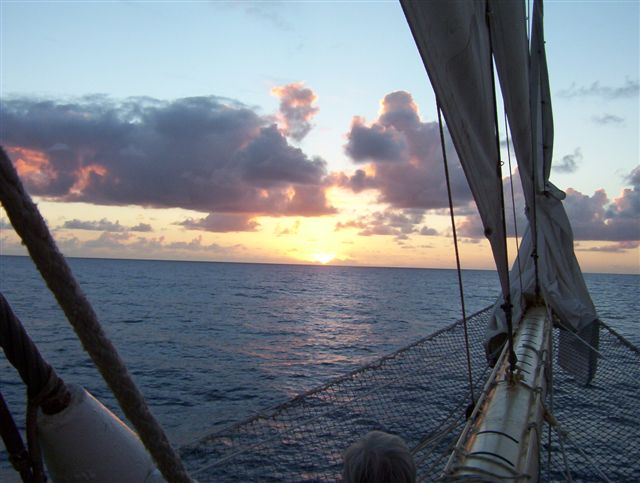
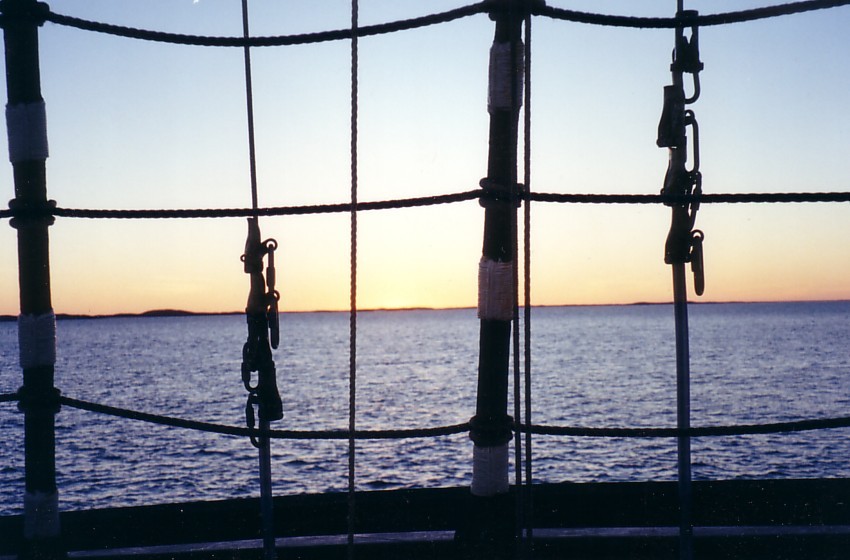
Photo: From the bow of the Star Clipper, Mid Atlantic 2004

Friday, June 09, 2006

SEA DUST - the romance of the sea and tall sailing ships


The following review of my novel 'Sea Dust' appeared in the Historical Novel Society's May journal. Reviewer, Fenella Miller wrote:

This is a well-written and interesting book which has been impeccably researched.
The vivid descriptions of Victorian Whitby, and ship board life, bring the places alive.
The author makes you feel as though you are walking through the streets and can actually smell the fish entrails and the body odours of the poor folk you pass.
The ship-board scenes make the reader understand what it is that draws men to the sea despite its dangers.
In this book the characters seem less important than the sea, the ship and the places. It is like looking through a window into the past – catching glimpses of emotions and events but remaining outside, not becoming involved.
Sea Dust is a love story, but not between the main characters, that is peripheral, it is about the romance of the sea and tall sailing ships.
This novel will appeal to anyone who has an interest in things maritime and a love of the past.
Ref : http://www.historicalnovelsociety.org

Saturday, May 27, 2006

Lost Lady of the Amazon

Unbelievable Amazon adventure
I have looked longingly at a voyage on a cruise ship up the mighty Amazon and added such a trip to my wish-list.
But imagine that journey in a rowing boat, battling the current all the way to the Andes. A voyage of 2700 miles that would take two thirds of a year.
And set the date in the 1760s! (Cook hadn't even set sail for Australia) - Remarkable!
Anthony Smith's narrative on the factual story of Isabela Godin includes Isabela's epic voyage from the Peruvian Andes in 1769.
''The Lost Lady of the Amazon is a true adventure story which any historical novelist would give his/her right arm to have thought of.''
I jotted down that statement when I was half way through Smith's book.
Then when I reached the chapter titled, Stranger than Fiction, I read the letter Isabela's husband had written to his friend telling him about her ordeal and saying that if you read it in a novel then you would ''accuse the novelist of not being true to life''.
His words were written in 1770.
Here is the Amazon.co.uk synopsis:
The French scientific expedition that set off for Peru in 1735 did not have much luck. Five of its members died or went insane before their seven years' work was completed, but Jean Godin, the youngest member of the team, fell in love with and married a local girl - Isabela, the daughter of the local Spanish governor.
After a few years, Godin crossed the Andes and travelled the Amazon to test whether it was a route suitable for his family. Unfortunately, having safely reached Cayenne in French Guiana, he discovered the political situation prevented his return...After almost 20 years, the King of Portugal sent a boat to retrieve the family.
Isabela at last set off with her children, her brothers and her servants, over the Andes and down the Amazon, but the journey was to prove worse than the waiting. Smallpox, starvation, the torrential river and the horrors of the jungle beset the travellers. Some drowned, some ran away, others died of hunger.
In the end, Isabela alone survived of the 42 who set off - she was found wandering in the jungle sick and half-crazed.
The Lost Lady of the Amazon - is an unbelievebale adventure recounting a page from history that few people are aware of.
photo: Amazon.co.uk

Wednesday, May 17, 2006

Smiling again

Had a slight hiccup.
Last Thursday, I thought I had indigestion but it wouldn't go away.
The surgeon said the appendix was green, so I guess it is better out than in!!
Glad it happened now and not when I was away in Europe!
Back to work...

Tuesday, May 16, 2006

Writing tall ships tales - leaning to fact or fiction?

Sailing a coffin ship to the Horn (several times)
Fiction writers of tall ship tales lean towards swashbuckling adventures - mutinous men and cruel and tyrannical captains. Most are set at the times of the Napoleonic Wars. They make for exciting reading and have a huge following.
Having just finished FitzRoy, I can see that only an immensely capable seaman could have embarked on, and completed so successfully, the five year circumnavigation, as FitzRoy did in HMS Beagle in the 1830s.
Originally rigged as a brigantine, the Beagle fell into the category known as a coffin ship. They were ungainly vessels which easily turned turtle. They also lay low in the water and were prone to heavy seas sweeping over the deck.
Fitzroy knew this and on accepting the commission, he added a third mast, (for increased manoeuvrability, thereby converting the vessed into a barquentine.
After spending almost five years in undoubtedly some of the roughest waters in the world, the Beagle returned to England having not lost a single spar. That was due entirely to the Captain's meticulous care and caution.
Only five men died during the five year period, one from old age, one from a shooting accident and three of fever while on shore in Rio. Not a man onboard was not full of admiration for FitzRoy.

Note: When I wrote the nautical section of Sea Dust, I was advised by an acadmic that there wasn't enough blood and guts in my manuscript and that my Captain was too mild mannered.
I'm pleased to say I stuck to my guns.
But as I mentioned, the stories which sell - from Treasure Island to Captain and Commander -are riddled with ever manner of disaster.
Perhaps I should change tack - adopt a male pseudonmy and head back out with all guns blazing.
The idea has crossed my mind more than once.
Photo: Barquentine, STS Leeuwin, sailing the Indian Ocean off Western Australia - M Muir

Wednesday, May 10, 2006

Books - FitzRoy

Robert FitzRoy's contribution to science, exploration and humanity was never fully acknowledged in his lifetime. Nor were the half million hand-written words he transcribed about his survey work and voyages. Being the Captain of HMS Beagle which carried amongst its scientific crew the young, Charles Darwin, Fitzroy's work, when published was dwarfed by Darwin's Origin of the Species . It was as recently as 2002 that Fitroy was acknowledged for the invention and instigation of a weatherforcasting system - a system which at the time of its first presentation to British Parliament was received with laugher in the House.
The boy sailor and marine luminescence
Born in 1805, like so many young gentlemen from artistocratic families, FitzRoy joined the Royal Navy at a very early age.
In 1818, at the tender age of only 13, he wrote a letter to his father.
It reads:
Last night when I was coming back, the boat I was in was going very quick, and I put my hand into the water and the little ripple of water it made Sparks, at least they looked exactly like it ... like from a flint and steel, and I could not make out what it was for the oars did the same...
He asks his father to write and tell him what it was he had seen.
FitzRoy and Sea Dust
It was during my first voyage on the tall ship, STS Leeuwin that I first witnessed marine bioluminescence.
I shall always remember the experience, sitting alone on bow watch in the early hours of the morning watching the tiny pin-pricks of light glittering in the sea, appearing and disappearing as if by magic.
I was amazed by the phenomenon and called the particles "illusive diamonds".
It was my "illusive diamonds" which inspired me to write my first novel, Sea Dust.

Reading the biography of FitzRoy by John and Mary Gribbin (2003), I felt an instant empathy for the boy sailor sitting in the small boat 200 years ago. I wanted to tell him I had marvelled at the sea's magic also.
Photo: FitzRoy by John and Mary Gribbin available from Amazon.uk.com

Sunday, May 07, 2006

In Search of Robinson Crusoe

Fact and Fiction interlaced with travel and history
I never read Robinson Crusoe – in fact I never read as a child or for most of my adult life.
Let me qualify that by saying I never read fiction.
I used to spend hours pouring over encyclopaedias and reading non- fiction (or faction as my son calls it – which I think is a far better word).
I can probably list on the fingers of one hand the fiction books I read and reread up to the age of 50: Neville Shute’s A Town like Alice being my favourite.
Yet the irony is I stated writing historical fiction five years ago without having read other historical novels.
One thing University (2001-2004) taught me was to read fiction.
I had to – it was part of the curriculum.
And I started where I should have done 50 years ago with Children’s’ literature.
Now I know what I missed out on.
Now I wish I had more time to read.
As a new reader I try to read across the genres but I find I lean towards historical, and mystery. I like stories based on true events. I lean away from sci-fi, horror and romance.
Having just finished Where the Earth Ends (a journey beyond Patagonia) by John Harrison I must go out and buy a copy of Robinson Crusoe.
I didn’t know the true story of Selkirk, the Captain who was left on an uninhabited island (in the Juan Fernandez Archipelago off the coast of Chile - not in the mouth of the Orinoco), the man who trained goats and cats to dance, the man who the fictitious character of Robinson Crusoe was based on.
John also whetted my appetite for Drake’s voyages around the Horn in the Golden Hinde. I must read those real-life adventures, also Richard Henry Dana’s, Two Years Before the Mast, which tells of his sighting of the (Crusoe) Juan Fernandez Islands in the 1830s.
Fortunately I had recently purchased the biography of Fitzroy, by John and Mary Cribbin (2003). Captain Fitzroy, besides being the inventor of the weather forecast, was the captain of HMS Beagle which took Charles Darwin to the ends of the earth. I also have a copy of Darwin’s The Voyage of HMS Beagle sitting on my bookshelf.
My only problem now is lack of reading time.

Note for John Harrison: I thoughly enjoyed Where the Earth Ends (see posting below). It whetted my appetite to know more about the places, the people and the history of this region. It allowed me to relive the fantastic voyage I took from Valpariso in Chile, via Tierra del Fuego and the Antarctic Peninsular to Buenos Aires in Argentina.
The top of my wish list now is to sail on a square rigger from Ushuaia to the Antarctic.
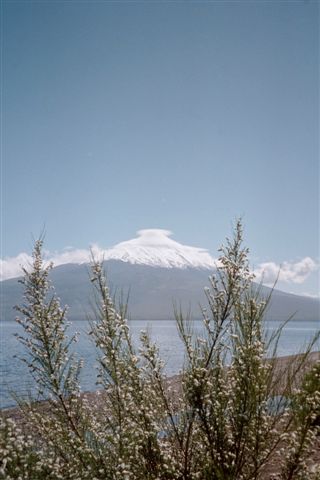
Photo: M. Muir - Osorno Volcano - Chile

Thursday, May 04, 2006

May - Marg's update

Writing:
Galley proofs arrived yesterday for The Twisting Vine.
This is when I check through all the changes that have been marked by the copy editor, proofreader and typesetter before the proofs are sent for printing and binding.
This is not the time for me to be making any further changes to the manuscript, but it is an opportunity to re-read the whole work.
If there are any mistakes which have not already been found, then I can make the necessary amendments.
Changes to the proofs should be kept to a minimum as they can be very expensive at this stage.
Note: Despite the most careful checking, I did find a couple of minor errors in SEA DUST when it came out in print. (I think it happens in most books).
Goats:
Buck and does searated last day in April - that means no kids to be born from beginning of October.
Travel:
Looking forward to holiday in six weeks.
Other:
For now a trip to Perth to see The Fastest Indian - with Antony Hopkins - my favourite actor - next in line - Antonio Banderas.

Friday, April 28, 2006

Guest Author - JOHN HARRISON Finds inspiration Where the Earth Ends


John Harrison's latest book, Where the Earth Ends is about South America and Antarctica.
In 2002, he walked 700 miles through the Andes for his next book, A Walk to the Sun, about the high sierra.
John was the first outsider some of those people had ever met.

‘My father’s family were seafarers, but he entered the airforce when WWII broke out.
After the war, he just wanted a nice safe desk job. Even our holidays were timorous affairs.
But I guess my wanderlust broke out, albeit a little late in life, when I had the chance to visit Kenya in my thirties. I don’t think I’ve had a European holiday since, apart from exploring the British Isles more fully.
There’s nothing like foreign travel to make you realise what you don’t know about your own land.
I always loved maps and geography, encouraged by Dad, who’d been a navigator.
My interest in travel writing also came late, after many years as a fiction writer.
It was travel and memoirs, rather than travel books, which inspired it. I wanted to try to encapsulate something of the whole experience of another place. I think it combines many of my interests. Over and above telling a story, I can play around and weave in fragments of history and myth, a love of landscapes and wildlife, and the layers of culture and literature that give human occupation depth and meaning.
I aim to provide a sense of spirit of place.
‘Where the Earth Ends’ was the result of reading a book called 'Uttermost Part of the Earth' by Lucas Bridges, the son of a missionary who ministered to the Natives of Tierra del Fuego.
Young Bridges was brought up among Indians still living a Stone Age life.
I went there. I had to write about it.
Out of all the things I’ve done, the thrill of getting my first book published matches any of them. When it was made a Sunday Times book of the week, I couldn’t quite believe it! It took a long time to find my métier, but it’s a lovely job.’
About John
Travel writer and environmentalist, JOHN HARRISON, is a native of Liverpool. For twenty years, he worked in planning and environmental matters. His short stories have been broadcast on the BBC and collected in A Short Primer in Vice. His last book, Where the Earth Ends, about South America and Antarctica, was a Sunday Times Book of the Week, and has been translated into German. It’s now out in paperback. Copies are available from Parthian Press parthianbooks@yahoo.co.uk
or if you’d like a personalised signed copy from the author, via his website http://www.cloudroad.co.uk
He is now writing and lecturing full-time, including working as a Field Education Officer for the Royal Society for the Protection of Birds. He has travelled to 42 countries on 6 continents, and has made radio programmes for the BBC on Antarctica and Easter Island.
John's particular interests are the links between real voyages and famous fiction, the remote cultures of southern South America, and the impact of exploration and conquest.
He is a Fellow of the Royal Geographical Society, a member of the Society of Authors, a Fellow of the Welsh Academy, a past Chair of the Welsh Union of Writers, and was for many years a Member of the Royal Town Planning Institute.
Photo: Amazon.uk.com

Wednesday, April 19, 2006

Antarctica - A blue world of ice and sky

Sailing South to the midnight sun
Since posting the blog about the yacht in Antarctica (pictured below) I have emailed various ultimate adventure groups in an effort to find the name of the vessel.
In the process I have discovered that there are several sailing ships - yachts, schooners even square riggers which visit the Antarctic Peninsula during the southern summer months.
Oh, to sail on a tall ship as the explorers of old did!!
I'd love to do it.
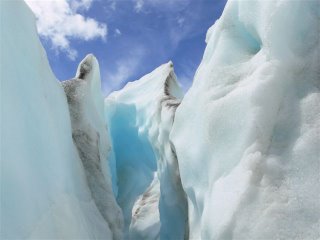
Photo of glacier ice - 'from the inside looking out' - courtesy Robert Dunn

Sunday, April 16, 2006

Deception Island, Antarctica


Safe Harbour in Volcano at the end-of-the-world
The quality of this picture is poor but the courage and audacity of the yacht’s crew for me commands the greatest respect.
I took this photo just over a year ago in Deception Island on the Antarctic Peninsula. (Yes, the word in is correct – I’ll explain later!)
Today I look at the picture and wonder who the brave sailors were who ventured there.
To have rounded the Horn is an awesome adventure; to have sailed across Drake Passage a challenge few would consider; to have contended with the tumultuous seas, icy winds and snow on a small yacht (albeit summer in Antarctica) is near unbelievable.
Having sailed to Antarctica on a cruise ship, I wasn’t able to relate to the experiences of sailing to those lethal latitudes.
The nearest I came was standing on deck for hours armed with a camera – my hands almost dropping off with cold.
But that alone allowed me to conjure in my mind an idea of what the early sailors would have endured on their voyages of discovery.
Deception Island is well named. It is not an island but a huge caldera of a (currently active) volcano. The land which surrounds it (as seen in the photo) sits out of the sea like the rim of a huge teacup. But unlike the white china appearance of the other Antarctic Islands the inside walls of this crater contrast starkly –they are thick with black volcanic ash.
The only entrance to the island is through a narrow crack in the rim but for those who find that entrance, the island's water is welcoming - calm in comparison to the unpredictably moody sea's outside, littered with treacherous icebergs; even warm in parts, where the volcanic activity below heats the water sending clouds of steam rising like smoke on the water.
Despite the inhospitable nature of this end-of-the-world location, in the summer months scientists live and work near the water's edge in the Antarctic Research Stations.
From the ship I saw two, each comprising of a handful of huts which priovide a temporary home in this desolate, virtually inescapable place - one of the most isolated places on earth.
Imagine my surprise, therefore, to see a yacht, moored as if it was in a fashionable harbour in some cold but peaceful bay or river.
In this case, however, the buildings in the background are not a yacht club, but the long abandoned remains from a previous expeditionary/scientific/whaling station.
(Perhaps there is an expert who can put me right here.)
I would love to know who the intrepid crew of the yacht were who had taken their lives in their hands, braved the elements and done what many seamen today and in the past would never contemplate doing.
I envy your courage!
Photo M. Muir – Jan 2005 Deception Island, Antarctica

Tuesday, April 11, 2006

GUEST AUTHOR - Broos Campbell - captured by the sea's magic


Broos Campbell is the author of the Matty Graves sea adventure series. The first book, NO QUARTER, was issued in hardcover by McBooks Press of Ithaca, New York, in April 2006
When I was 40, I ran away to sea.
I’d grown up reading the Hornblower books and I wanted to see for myself what square-rig sailing was like.
And I didn’t like it.
I hate being cold and wet, which sailors are most of the time. And I hate making a fool of myself, which there’s plenty of opportunity for in a tall ship.
But it was only a two-week stint, anyway, in the brig Lady Washington out of Grays Harbor in Washington state.
We’d motor out of the harbor and then the captain would cut the engine.
There would be a terrible lull, with the waves lapping at the hull and the masts swaying in the swell.
Then the captain would call, “All idle hands, lay aloft!”
There’s no “after you, mate” in a square-rigger.
If you’re next to the windward shrouds when the call comes, up you go.
It’s that or go ashore. No one trusts you, otherwise.
We were coming into harbor one evening after I’d been aboard about a week.
We’d furled everything and had nothing more to do till we reached the dock but loaf around.
I was sitting on the fore topmast yard talking to an old hand.
She looked around at the forest stretching off into the distance and the setting sun lighting up the clouds with God rays, and said, “Don’t you just love it?”
I said no, I hated it.
She said she’d hated it too for the first week, but then suddenly it had become magical.
I didn’t believe her.
I was too ashamed of my misery to find my way out of it.
But the next evening there I was again, in the same place, dangling my feet and looking around at the view - and it was magical.
I suddenly realized I was exactly where I belonged and I had no desire to be anywhere else in the world.
It’s hard to come by that sort of serenity.
You won’t find it in a bottle, and you won’t find it in someone’s arms.
You can only find it by being absolutely worthy of the trust that others place in you.
That’s the only place I’ve ever found it, anyway.

To find out more about the Matty Graves series, try e-mailing Broos. He can be reached through his admittedly rudimentary Web site at http://www.broos-campbell.com/
Broos' photo by Walter Mladina

Marg's update - Bitten by the bug

At long last the muse has returned and I am back to solid writing!
Not sure of the title of the next book (possibly The Black Thread) but it's set in Yorkshire (where else?) in the late 1800s.
By Chapter 4 the protagonist is on the run.
Can the Leeds/Liverpool canal offer a means of escape?

After reading of my interests, Andrew Denny, master of, Granny Buttons, a narrow boat, asked if there would be a goat in the next book. He told me he once saw a goat on a barge on one of the English canals. I wish I'd seen that.
Maybe I can sneak one in somewhere....
PS - Thanks to Andrew for the information I have gleaned from his site and the canal links it has taken me to.
Definitely worth a visit: http://www.grannybuttons.com/granny_buttons/

Wednesday, April 05, 2006

The Narrow Boat - sliding into the past


The days of the old working narrow boats are gone and today most canal barges are used as pleasure craft.
The history of the canals however is intruiging.
I'm currently reading the book, Narrow Boat, by LTC Rolt which was first published in 1944.
It's a beautifully written testament to the old boats and reading it transported me back to the days when the canals were still thriving, though at the time of writing, the signs of them being neglected and falling into disuse were definitely showing.
I remember crossing the Leeds/Liverpool everytime I went into to Leeds when I was a girl.
The canal looked black and dismal and its littered banks were an area to be avoided.
It is wonderful that many of the canals throughout Britain have been cleaned up and are in use again, albeit for holidaymakers.
Back to Mr Rolt's book:
Reading about the narrow boats with their polished brasswork and painted decorations of flowers and castles, about the boatmen and women and their traditional dress, about the pretty lock cottages and Inns and the operation of the staircase locks, I find everthing connected with the narrow boat inspiring.
So much so, my next story incorporates the Leeds and Liverpool canal of the 1890s in its pages.
At the moment I haven't got a working title but am considering - 'The Black Thread'.
When I visit Leeds this year, I will make a point of re-visiting the canal and learning first hand how the lock paddles operate - and I must get some photos.

Photo curtesy Andy Roberts Inland Waterways - http://waterwaysphotos.blogspot.com

Books - 'Sea Dust' - SOLD OUT ALREADY


Great news this week - just heard that my novel, 'Sea Dust' has sold out of its first print run.
Hale Books, the publisher has only 2 hardback copies left in stock.
With my second novel - 'The Twisting Vine' - due in August, I am hoping it will be as well received.

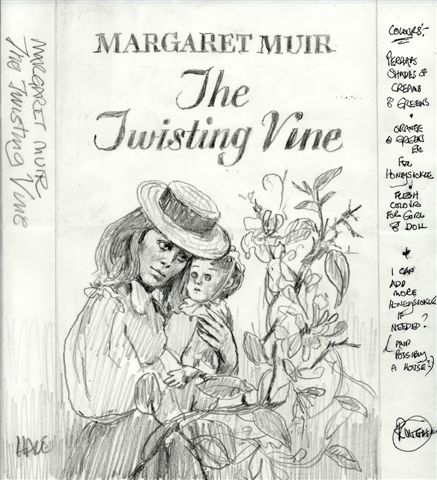
This is the artist's cover rough for 'The Twisting Vine'.
I feel that the girl has a hard face and have asked that it can be softened.
It is not a baby she is holding, but a French Bru Doll.
The doll has an unobtrusive presence throughout the story and I had written this novel under the title, 'Through Glass Eyes', however the publisher did not like it, hence the change.
Cover rough for The Twisting Vine by unnamed artist - courtesy of Robert Hale Books, London

Monday, March 27, 2006

Guest Author - Maggie Lilleby on writing, travelling and cycling


Maggie is a children’s writer. She lives in Nelson New Zealand.
It’s often said that as kids, writers were always scribbling.
I certainly was. I didn’t keep any of the old stories, poems, songs, and plays I wrote – I wish I had, they’d have been funny and probably embarrassingly awful to read now.
I was always a great reader, too, my favourites being the Greek, Roman, and Norse mythologies, and the stories of King Arthur, Merlin, and the Knights of the Round Table. Mary Stewart’s Merlin quartet (The Crystal Cave, etc) still rank among my favourite books.
Although I’ve written adult short fiction and many non-fiction articles on travel, health and fitness, and cycling, I’ve focussed mainly on writing for children.
My first children’s book was published in 2002, a sporting novel about cycle racing.
I found it relatively easy to write as I’d long been a fanatical cyclist and had raced myself on road, track, and mountain bike. I represented New Zealand at the Oceania Games in 1986 – not a particularly successful exercise as I crashed after a few kilometres.
I enjoyed writing the book as I put a lot of my own knowledge, enthusiasm for the sport, and experiences into it. Currently I’m working on ideas for another children’s novel.
Much as I enjoyed cycle-racing, cycle-touring was always my first passion, especially in France. I have visited five times. France is an amazingly beautiful country, perfect for cycling – some fabulous countryside, and I love the medieval villages, castles, and churches, and of course the food and wine! And everyone is either a cyclist or a cycling fan.
Unfortunately, I don’t do as much cycling now, but I still love the sport. And I’m never happier than when I am whizzing around on my bike!
One of the highlights of my year is watching the Tour de France on video. I actually followed a couple of stages of the Tour in the Pyrenees several years ago – totally blew me away. As far as I’m concerned, those guys are super-heroes!
I also write a lot of children’s non-fiction, mostly for the New Zealand School Journal and other educational publishers, including the US/Canada market. I’ve learned an awful lot about such diverse topics as orienteering, sea-kayaking, belly-dancing, kite-boarding, mountaineering, tsunamis, the Bermuda Triangle, and extinct and endangered species.
Writing for and about kids is fun – you get to share in their enthusiasm, imagination, creativity, and energy.
Maybe I’m just a big kid at heart!
photo: Robert Dunn - 'The Remarkables', nr Queenstown, NZ (2005)

Saturday, March 18, 2006

Back on Track


Goat track: Autumn in Western Australia and time to introduce the bucks to the does. Necessary but noisy!

Writing track: Not on track – the writing will not flow – too many distractions and the mind doen't want to work in a disciplined manner.

Holiday track: YES!!
Been busy organising a holiday to UK and Europe, travelling initially with my son.
The mind is working overtime here!
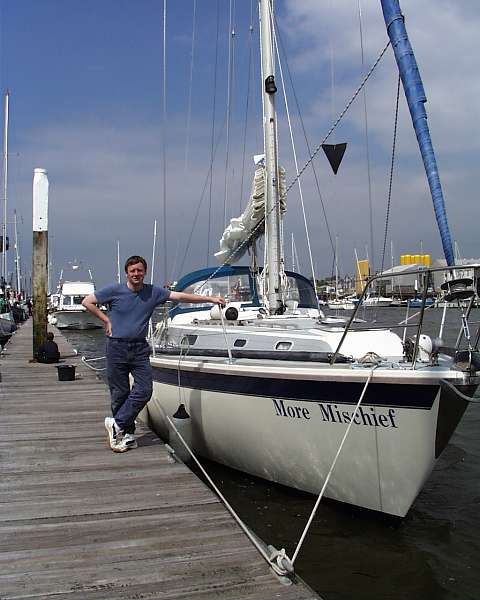
I recently discovered my brother, who lives in the south of England, not only has part share in a yacht but also an aircraft.
He has offered to take us sailing for a couple of days out of Portsmouth.
Because I love tall ships, I am looking forward to seeing Nelson’s “Victory”, and the “Mary Rose” if possible.
If we take a flight it will be over the Isle of White and Portsmouth Harbour – UNREAL!

Because I love also ocean cruising , I have been tempted by a cruise in the Mediterranean.
Ten days sailing out of Rome to Naples, Greek Islands, Sicily and South of France and Florence.
I’m just in the process of working out the best way to get there.

When I am in the UK, I hope to visit Hale Books who published SEA DUST and to meet the agent who secured that contract and the contract for my second novel, THE TWISTING VINE. I could not have managed to get where I am without him.
You can read a progress report on where the publishing process for the book is at at the moment at: http://squidoo.com/thetwistingvine

Photos: Bro with boat (cutesy Nigel Leak)

Big Boy's Toys


My son's eye's lit up when he heard about the chance of a flight.
"I've jumped out of a few of those," he said.
I just hope I don't have to jump out!

Photo curtesy N. Leak

Monday, February 27, 2006

Book launch - The Sweetest Taste


An Aussie author said that the champagne to celebrate the launch of one's first novel was by far the sweetest.
I'm sure she was right!
With forty friends and my son, Rob, alongside me, we gave Sea Dust a great send off.
I had a wonderful time.
(The Large Print rights to Sea Dust have been sold to Thorpe Publishing, London. It will be published in 2006)

Sunday, February 26, 2006

SEA DUST launched


It's a bit belated but today it's happening.
I am celebrating the launch of my first novel, Sea Dust, published by Robert Hale Ltd, London.
Sea Dust was released in the UK in December 2005 and Australia this month (Feb 2006).
This afternoon, my son, Rob, will official launch the book at a small party held at home.
I will not be breaking a bottle of champagne over it, but I will make sure we hear a few corks popping!
Though I say it myself, "Here's to Sea Dust!"

Thursday, February 09, 2006

Nursery rhymes – the cornerstone of learning

Baa, Baa - not such a black sheep!
Nusery rhymes have been around for a long time.
Possibly the oldest line from a nursery rhyme is Eena, meena, miny, mo, reputed to have been recited by the Druids thousands of years ago when they picked their victims for human sacrifice.
But whatever their purpose or attraction, nursery rhymes have survived the centuries and are one of the infant’s earliest encounters with the English language.
Walter de la Mare described nursery rhymes as:
‘tiny masterpieces of word craftsmanship – of the latest device in rhythm . . . not only crammed with vivid little scenes and objects and living creatures, but, however fantastic and nonsensical they may be, they are a direct shortcut into poetry itself.’
Nursery hymes teach rhyme and rhythm, and through repetition, they teach the alphabet.
They introduce the child to words, sentences and syntax with rich examples of figures of speech such as tongue twisters (How much wood could a woodchuck chuck) and alliteration, (Sing a Song of Sixpence).
And with an appreciation for words and verse, the child learns to read.
This, in turn, later provides the author with a market for both children’s and adults’ books.
Modern English of the twentieth and twenty-first centuries has been modified in line with changes in culture and society.
Since the Middle Ages there have been wars, plagues, and the Industrial Revolution.
Today, space exploration and DNA cloning are things of the past.
Yet despite this, the poetry of the nursery rhyme has survived and almost all of today’s great leaders, writers and philosophers (though they may not like to admit it) have cut their teeth on ‘Baa Baa Black Sheep’ and ‘Humpty Dumpty sat on a wall’.
Photo of one of my melanian sheep with lamb - M. Muir

Tuesday, February 07, 2006

Writing for Children

The day the scarecrows came to town
I got the idea for this children's story after visiting a Small Farms' Field Day held in a country town in Western Australia.
One of the main events was a scarecrow competition.
I was amazed, I had never seen so many scarecrows!
They were big, small, fat, thin, and dressed in all manner of costumes - guaranteed to send the imagination haywire!
My story, about Sam a rather delapidated straw man, had quite a cast of scarecrows in it.
And I even wrote a sequel.
Unfortunately, my limited attempts to get the story published were unsuccessful.
Perhaps now, with a little more knowledge of the publishing business, I should try again.

Photo: Me and a scarecrow at Balingup several years ago. The scarecrow is the one with the long nose!

Thursday, February 02, 2006

Writing for Children - goats always popular


The Three Billy Goats Gruff
"Whose that tripping over my Bridge?" roared the Troll
Children love goats and they also love stories.
But to write a good children's story is an art. Getting published, even harder.
Because a children's story is short, it looks easy - but I assure you, it's not!
I've written a few children's stories - but never sold any.
The problem is, the of type story I write, is the type I listened to when I was a girl.
Now that was some time ago!
Today's kids live in a different world to the one I grew up in - they face different challenges - learn different things.
Consequently, the stories they read must appear within the sphere of their world.
Writers who have discovered that special link to the childhood imagination are lucky. With the right formula they are in demand from both readers and publishers.
In the meantime, I think I'll stick with the adult stories and the goats!

Photo: M Muir - Three of my angora bucks at Bluegum Park in Western Australia - visit my goat site at http://www.squidoo.com/goatlady